Showing posts with label Africa. Show all posts

Sunday, December 15, 2019

An African Memory: Waiting in the Dark

I remember Carol Concerts in Bulawayo’s Central Park. I remember the wonderful descant to “O Come all Ye Faithful” on “Glory to God, all glory in the highest” – sung in the small city hall at a combined choirs carol concert. I remember candles and music that shaped my heart as a child.


Advent is a different time than Christmas, even though it is the time was always had our Christmas concerts. Advent is for waiting, and my African memory is of a time I don’t remember, although I was there. An African memory of waiting in the dark for someone to be born.

[The pictures are from Google images -- of the Central Park, but not of the amphitheatre where we had carols by candlelight, and of the City Hall where we also had carol concerts.

My older sister tells me the story. Our mother was waiting for a child, expecting her third baby. The life of her second was short – eight months long, before Dorothy died of malaria and was buried at our home in Sikalongo. [The picture below was taken in 2003, as Lois and I and our sons visited Sikalongo and reconnected with the memory of my sister, Dorothy.]


Perhaps as a result, mother went to the nearest hospital well before the birth of her next child. Livingstone was the nearest city with a hospital, so she and my sister Donna and another missionary, Verna Ginder, went down to Livingstone in a 1948 Ford Pickup.

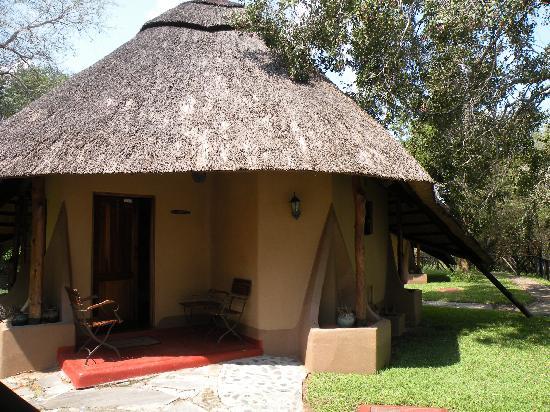
I have wondered what they talked about. Verna had lost her husband to a tropical fever a few years before. Mother had lost her daughter to malaria. They may have identified closely with each other. They stayed in some government rondavels (a nice hut with a thatched roof) beside the Zambezi River, just above Victoria Falls. After several days by the river, mother announced that her labour begun.


[Pictures taken from Google images: the rondavel was probably not quite this nice, and this hospital -- in Livingstone, Zambia -- may be newer. But you get the idea.]

They drove to the nearby hospital in the 1948 Ford and hurried inside. I don’t know anything about the labour (although I am told I was the cause), but I gather that during labour the mother delivering the baby does not think about anything else. So Donna remained in the Pickup, momentarily forgotten.

I don’t remember what time I was born, but finally the time came, with the night well spent. Donna spent that same night in the dark of the African night, wondering where her mother and Aunt Verna were as she sat in the 1948 Ford Pickup. After I was born, someone thought of Donna. Maybe mother asked, “Where is Donna?” And maybe Verna Ginder rushed out horrified to make sure Donna was safe. Maybe Donna had fallen asleep; maybe she was just glad to see someone she knew.

In any case, they hurried back into the hospital so that Donna could find out what had kept mother so occupied. As a five-year old child, she was maybe less than impressed with the discovery of her baby brother. “That was why you left me alone in the dark?”

She has been a good sister, for which I am grateful, and mother was a good mother, for which I am doubly grateful. Her experience of waiting in the dark is a paradigm or model of the way we all are waiting for the night to end, trusting that God brings us this Christmas the joy of new birth and new life. Maranatha!

Wednesday, February 21, 2018

Reflections of a White African: 5 (What’s so special about Africa?)

I have been asked to talk about Africa. I was born in Zambia and lived in Zambia and Zimbabwe for over 20 years. I lived in the USA for 25 years, and now also in Canada for 20 years. I have layers of identity (as most of us do), with Africa at the centre, so that Africa lives in my heart.

I grew up in a country run by a small White minority. When colonial Rhodesia became free Zimbabwe, many of my fellow White Africans “took the gap” – they left the country never to return. I am in contact with some of them. They are good people, but they miss the privilege that we had when half of the country’s resources were spent for a minority of five percent.

Some of them miss Zimbabwe for other reasons. Some have stayed in Zimbabwe, because Africa is home and they don’t want to live anywhere else. My question this evening is: What’s so special about Africa? What has caused White Africans to remain when they are no longer in control of the country? Why do some return after living elsewhere.

The answer varies from person to person, so I am speaking only from my own experience. I think that what I have to say applies more broadly, but you will have to talk with people from other countries in Africa to find out if what I say about Zimbabwe is true in their homes as well.

What’s so special about Africa?
1. Some people point to the scenery and the animals out in the bush. Having an elephant stalk past your little rondavel, brushing against the window as it passes, is an incredible experience. I have driven through a herd of water buffalo – slowly, not wanting a stampede – with the sound of a Wild West movie playing inside my head. And the scenery! I was born near Victoria Falls – twice as wide as Niagara Falls and one and a half times as high. Immense and powerful, with spray that drenches the surrounding grassland and turns it into a rainforest.

The truth is, of course, that Africa is incredibly beautiful, but so is the rest of the world around us. From China’s Great Wall to the Canadian Rockies, from the Rift Valley in East Africa to the Ruwenzori Mountains of the Congo, from Iguassu Falls in Brazil to the Taj Mahal, we have beauty all around us. Africa is beautiful, but that is not the primary reason that anyone would choose to go back home to live there.

2. Some people remember their youth, and they think that what they had when they were young was clearly better than anything since. This would be true for those with whom I grew up. Often they are right, but they forget the human cost of what we had. I remember Rhodesia of old. There were 300,000 White people at the most, and about seven million Black people. The White schools were excellent, but there were only a handful of places for Black scholars.

I remember the situation when I was a teacher there in the early 1970s. Consider, after grade seven Black Zimbabweans took an exam to see who could go on for further studies. The top 12 percent went on to high school. Then after grade 12 (as we would call it), they took another exam, and this time the top eight percent went on to university or teacher training college. Roughly one out of 100 Black children were able to pursue higher education. No wonder we had high standards! The whole process was built on systemic injustice. Those who think that colonial Africa was better forget the human cost of the colonial system. Remembering the old days is no reason to call Africa special.

3. I know what I miss. I love Zimbabwean music and the sound of the people singing and speaking, laughing and being. There are certain foods that I miss. I miss biltong and Marie biscuits, lemon cremes and gooseberry jam. I miss the crumbly Cadbury’s chocolate I used to get in Bulawayo and the licorice that was actually more green than black. I miss buying shelled peas from the vendor on the way home, not to mention roasted peanuts poured into a funnel made out of newspaper. I miss mealies (corn on the cob) roasted over a charcoal fire.

I miss the African night, so dark that you can really see the stars. I miss idonsakusa and icela inkobi – the names of the morning and evening stars. I miss the Southern Cross, which you can’t see in the northern hemisphere. I miss the sounds of the birds, the grey lourie crying “G’way!” I miss the brightly coloured lizards that scamper about the rocks. And I miss the rocks themselves, big boulders that make themselves into mountains in the Matopo Hills, where I grew up. But none of these things are what I miss the most. None of these things are really what makes Africa special.

What makes Africa special?
Our son once said that he wanted to go back to Zimbabwe to live. He was about 10 at the time and had been five years old when we left Zimbabwe. I asked him what was different about Zimbabwe from North America. He thought for a bit, and then replied, “In Africa, they treat people like people.” Bingo! That’s what’s special about Africa!

We have a saying in Zimbabwe. “Umuntu ngumuntu ngabantu.” Literally: A person is a person with people. More fully: You become a real person (fully human) in community, in relationship with other people. Desmond Tutu used to describe this quality of life in Africa as “Ubuntu” – humanness. When one person hurts, the whole community gathers around that person. When someone dies, we gather with the bereaved family and make sure they do not have to face death alone. When someone is in need, someone else will leave what they need at their door. No questions, no fuss, just care.

Canada is a great place, but we prioritize tasks over people. We care for each other, but we value getting things done even more. In Africa, we prioritize people over tasks. We want to get things done, but “in Africa, they treat people like people!” That’s what makes Africa special.

Sunday, February 04, 2018

A Story of Passports

I wonder what the plural is for a group of passports -- a murder of crows, a flock of birds, a herd of cattle. Maybe, a story of passports?

My siblings and I went through Dad's stuff this past July, after Dad's funeral. He had made sure that we had taken most of what we wanted before he died, but a small room remained. His last home on this earth. In these remnants of our parents' lives, we sifted through various items. Then we handed our selection to Nevin to keep at his house, since Lois and I were flying home.

When we visited for Christmas, Nevin handed us back our stuff, several boxers symbolizing Dad's life. I found his collar and dickey -- a black dickey (sort of like a bib) with white collars, which he used to wear as a minister in Zimbabwe, more than 50 years ago. I tried to see if I could put it on, but the collars are faded and brittle. I am ordained, as he was, but I will stick to normal Western wear.

I found two of his pocket knives. Dad was never without a pocket knife, for use, not for show. With me, they are purely for show. I found his date books -- 50+ years of date books. In the last year of his life, he weighed himself daily and recorded his weight. He had trouble keeping his weight up, so he chronicled his daily journey to eat enough eggs and get enough protein.

Finally, I found an envelope. A large plain brown envelope with the address of BIC Missions and some stamps. Inside I found passports, dated from 1946 to 1963. Here (briefly) is their story.


1946. Just after World War Two. Mom and Dad were scheduled to travel to Africa to begin their first term in Zambia, but pent-up demand for berths made it almost impossible to find space to sail to England. Dad told me the story of how one day he and Grandfather C drove to New York to look for tickets to sail to Africa. After much searching, they found a travel agent who told them he could get them seats on an airplane -- not the way we normally travelled in those days. Dad and Grandpa drove back to Lancaster County, Pennsylvania and out to Ira Musser's farm. Musser was the missions board secretary, and in charge of getting them to Africa. They found him in the field, ploughing, and asked him if they had permission to buy the tickets. he immediately told them to buy the tickets and to get seats for the rest of the missionary party also. I think their party consisted of eight people: Mom and Dad and Donna (above), Lewis and Gladys Sider (with son John), and Lulu Asper, Rhoda Lenhert, and Florence Hensel.

They flew from New York to Gander, Newfoundland, where they were unable to land because of fog. I think they went to Monckton, NB. The next day they went on to the Azores islands, two-thirds of the way to Portugal, and then on to Portugal. From Portugal they flew to Dakar, Senegal, and then on to Monrovia in Liberia.  Finally they flew to what today is called Kinshasa, Congo, and then to what is now Lubumbashi. The last stage of their journey was by train, from Lubumbashi across the border into Zambia, and then on south to their destination in Bulawayo. They arrived in Bulawayo on Christmas Day, 1946. The beginning of almost 20 years in Zambia and Zimbabwe. Their passport has the stamps from government officials chronicling their journey. A story of passports.


1950. I suspect that the passports had a five year limit, since their next passport includes me, issued four years later. They travelled on a family passport, showing and signed by David Climenhaga and Dorcas Climenhaga, and adding the names of their children, Donna and Daryl. I think I can see some weariness in my parents' faces. They had another daughter in between, who never made the passport, Dorothy Leigh, born in April 1948, and died in November, 1948. Expatriate life is often hard.


1956 (I think). Just before Denise joined the family. A typical missionary family photograph. You can see the collar and dickey my father wore, sort of like an Anglican priest. Odd, for Brethren in Christ folk, whose motto was simplicity, but understood by the people around us in a British colony. The same reason that my parents finally bought a wedding ring for mother about five years later. It stopped the English from thinking that they were not married, but "living in sin".


1957. Denise was born, and we added her to the family passport by the simple expedient of adding a picture of mother holding her, signed before the relevant American authorities. So much simpler than life is today. Denise looks unimpressed by the proceedings. I like the way that the side view shows mother's covering, a part of her dress that I took for granted for the first 15+ years of my life. I notice also (at least I think I saw this) that, when she stopped wearing the covering, it disappeared from her clothes entirely. Dad took off the collar and dickey at the same time, but it was still in his dresser drawer when he died, just over 50 years later.


1959. This photograph appeared in the book of missionary families in 1960, a copy of which sits in my office. here it served first to include Donna and then to remove her from our family passport. We must have travelled home to the USA on this passport in 1959 as a family. Donna remained in the USA when we returned to Zimbabwe the following year. As a result, she got her own passport, and had to be removed from the family passport. Again, a simple procedure, appearing before the relevant American official, who crossed her off, and it was done.


The last two passports complete the journey. I think that these were the first individual passports they held. Denise and I got individual passports at the same time. A little context. This was a period of political instability. Dad was the bishop of the church and general superintendent of the mission. If troubles of some sort or other broke out in Zimbabwe, especially in Bulawayo where we lived, individual passports enabled us to travel separately if necessary. Dad could stay behind and keep things going, while mother and Denise and I could head for South Africa and home.

I have wondered about that time. I remember getting my passport. It felt cool, and I felt grown up. I'm not sure I would have felt quite so pleased if I had known why I now had my own passport. Two years later we left Zimbabwe. I returned for three years in the 1970s, so that I was there for the beginning of the Liberation Struggle, but that's another story. A story of passports.

Saturday, October 29, 2016

The Excuses of Moses

You know the story of Moses: Exodus 1 sets the scene—a “Pharaoh who knew not Moses”, combined with the increase of Jacob’s family, “the Children of Israel”, led to a situation in which the Israelites provided slave labour for the Egyptians. Life is hard, and the more the Israelites increase the worse their lives get.

In chapter 2 we read about the birth of Moses. In a setting where the Egyptians are trying to kill all baby Israelite boys, a Levite man and woman get married and have a baby boy—Moses. His mother hid him for three months, but finally tried an unusual adoption process. She put him in a basket in the river, where Pharaoh’s daughter found him and took him in. So the slave baby grew up in the king’s house, to all intents and purposes a brother to the man he will later challenge to “let my people go”.

But then the story takes a dark turn. Moses grew up. We are left to infer that his mother (who was hired to be his caregiver) told him about his real parentage, so that when he saw an Egyptian fighting with a Hebrew slave, he intervened—and killed the Egyptian. As a result he fled to the land of Midian, where he found a wife and started his family, living with his wife’s family in Midian. Notice that her family thinks of him as an Egyptian.

Chapter 3 moves the action to a climax. The angel of the Lord, who turns out to be the Lord, called to him from a burning bush as he watched his father-in-law’s flocks. The Lord told Moses that he had seen the Israelites’ misery and was ready to set them free. He called Moses to do his work: “So now, go. I am sending you to Pharaoh to bring my people the Israelites out of Egypt.” Moses protested that he was not important enough for such a task, and in response God revealed himself to Moses more fully.

This passage—with the divine name and the connection to Abraham, Isaac, and Jacob—is worth a separate session, so I pass over it this morning. God also promised clearly that the venture would be a success, because the Lord would do it. “I will make it happen.”

All of this sets the stage for Moses’ response to God’s call in the passage we heard this morning, which we can lay out simply as a series of excuses, combined with God’s assurance of help for each problem—real or imagined. The point is fairly simple: When God calls, the only acceptable response is yes. You remember the way that Isaiah responded in Isaiah 6:8, “Then I heard the voice of the Lord saying, ‘Whom shall I send? And who will go for us?’ And I said, ‘Here am I. Send me!’” Moses does not “Send me.” Instead, he makes a series of excuses, ending with “send someone else.”

The Excuses of Moses
Moses says: They won’t believe me.
·         God gives him instructions for a series of miracles: Moses’ staff turns into a snake, then back into a staff; Moses’ hand turns leprous, then clean again.
·         Now Exodus does not give a further protest from Moses, but I have a hunch that the writer was just saving space. Clearly Moses is not convinced, because God gives him instructions for a conclusive miracle when he gets to Egypt: “If they do not believe you or pay attention to the first sign, they may believe the second. But if they do not believe these two signs or listen to you, take some water from the Nile and pour it on the dry ground. The water you take from the river will become blood on the ground.” You would think that Moses should be impressed by now. The God of Abraham, Isaac, and Jacob, the God of his fathers, the God who controlled all of nature demonstrated his control before Moses—from the bush that burned without being consumed, to sticks that turn into snakes. So what does Moses do?

Moses said to the Lord, “Pardon your servant, Lord. I have never been eloquent, neither in the past nor since you have spoken to your servant. I am slow of speech and tongue.” His basic excuse is: I’m not a good speaker. He sounds like someone trying to get out of a Homiletics class.
·         The Lord’s response is briefer this time. One can sense a divine impatience: “Who gave human beings their mouths? Who makes them deaf or mute? Who gives them sight or makes them blind? Is it not I, the Lord? Now go; I will help you speak and will teach you what to say.” Although God’s response is brief, I am impressed with the divine humility expressed. I think that God actually acts this way with us many times. God calls us to say or do something, and we feel inadequate. We can express our inadequacies and our fears to God, because God gives us whatever we need to do what God calls us to do.

But Moses brings out his clincher: “Pardon your servant, Lord. Please send someone else.” This is the only real excuse Moses has. This is the only excuse God will not accept.
·         Then the Lord’s anger burned against Moses and he said, “What about your brother, Aaron the Levite? I know he can speak well. He is already on his way to meet you, and he will be glad to see you. You shall speak to him and put words in his mouth; I will help both of you speak and will teach you what to do. He will speak to the people for you, and it will be as if he were your mouth and as if you were God to him. But take this staff in your hand so you can perform the signs with it.”

God provides for the previous excuse, while brushing aside this final excuse. Ironically, the Egyptian court will be faced with a strange scene—a herdsman from Midian will enter the premises with a despised Hebrew slave as his spokesman. But when the herdsman opens his mouth, they will hear the voice and accent of the Egyptian royal family. If they listen carefully, they might also hear the laughter of God somewhere in the recesses around them.

Our Calling—Our Excuses
As others have spoken about God’s calling, we have observed a variety of ways that God’s call operates in our lives. I am talking about the way that God calls us to various tasks throughout our lives. As students approach the end of your UC or seminary experience, you may wonder what exactly God calls you to do. I doubt that you will find a sign as clear as a bush burning on campus, without being consumed, and a voice speaking from within the bush. Instead you may follow Moses’ example of finding a place where you can get a job and start a family, but in all that you do God is working to prepare you for something. Most often we make our choices and discover afterwards that God was at work throughout.

I have found myself in situations that I wonder why I am the one God called. I have been a “missionary” (although I am not sure what that word necessarily means). I have been a pastor, not that I understand “pastor” much better. Now I am a teacher. I am also a husband and father, and a member of my church in Steinbach. In each of these places I have a job to do, a part to play—God’s person for the moment. Often I find I am out of my depth and helpless, but that’s okay. God calls and we respond.

We may wonder why God calls us to do the tasks we find in front of us. In Moses’ life, God prepared him over many years for the task of leading the Children of Israel out of Egypt. It may also be in our lives that God prepares us for a specific task for the benefit of others, but it may also be that God prepares us for our own sake. God acts in us what God wants for our own good. An important theme in Moses’ life was intimate conversation with God. When we meet him at the beginning of Exodus, Moses is impulsive and hardworking. By the end of his life, Moses wanted to see God and know God more than anything else. The account of the transfiguration in the gospels lets us know that Moses received what he wanted most: not only did he enter the Promised Land and talk there with Elijah, but he engaged in intimate conversation with the Son of God. God made Moses into what God wanted him to be, and wants to do the same with us.

A hundred years ago Brethren in Christ people used a particular image to describe God’s call. They talked about meeting Jesus, who was carrying a bag or a box containing all of the events to come in their life. My Aunt Arlene, married to my Dad’s older brother, Uncle Arthur, told how she had a dream in which Jesus told her not to worry, because all that would come in her life was in the box that he held out in front of her. I remember Arthur telling about his life with Arlene, and the way that she trusted God to …
·         Arthur told how her test to find out if God was calling her to Africa or to India involved him. When he asked her if she would date him, she herd, “God just called me to Africa.”
·         Each step from then on—it’s all in the box: As they moved from California to Zimbabwe, to Pennsylvania, to Illinois, and finally back to California.
·         He told how in their time at Wheaton, she was overcome with loneliness. He offered to move back to California; she replied, “It’s all in the box. We’ll stay and finish your work.”
·         Then they moved back to California, and their joy of being back was cut short by her cancer, Hodgkin’s Disease. She learned what it means to say, “It’s all in the box.”
·         He told of their last drive together into the hills around Upland, California. She said, “Arthur, 52 is so young to die, but as I look back, I wouldn’t change anything. It’s all in the box.”


In my own life the hardest call to follow was God’s call to stop doing something. I remember when our time living and working in Zimbabwe came to an end. I was resisting it, when the preacher in a service started to sing, “Mayenziwe intando yakho.” [From the Lord’s prayer: “Your will be done.”] Whether God leads you into exotic places or to work a lifetime in Steinbach, keep listening for God’s voice—or watching for a burning bush—and when God calls, he accepts only one answer: You can make any excuse you like, but then you say, “Yes!”


Exodus 4: 1-17
Community Chapel
26 October 2016