Saturday, August 24, 2013

"The Four Loves"

Steinbach Mennonite Church
25 August 2013
“The Fruit of the Spirit is Love”

Introduction
I admit to some surprise when I looked over the qualities in the fruit of the Spirit and found that this pre-eminent quality of love still available. All but two had been taken, and “love” was one of them. So I took it! Love is one of the primary qualities that our society admires. We have a variety of ways in which we lift up this one quality of love. “Love makes the world go round,” we say. For many people, the verse from 1 John that says “God is love” is the only part of the Bible they actually believe. We place love at the centre, and so does Paul in his list of the qualities in the fruit of the Spirit. Love comes first because everything else expands what it means and builds on this fundamental quality of love. So let’s talk this morning about love.

“The Four Loves”
Human Loves
You may have heard that where we have one word for love, Greek uses at least four words—storge, philia, eros, and agapé. Let’s look at these quickly.

Eros is the one most people know about. When the Beatles sang “All you need is love”, they meant eros: sexual love. The ancients knew all about eros; they called the goddess behind this love “Venus” (Roman) or Aphrodite (Greek). One of the odd things about our own culture is that we have decided that eros must be the centre and primary glue of marriage. In point of fact, eros is basic to marriage; but a lifelong commitment to another person goes much deeper than the physical love we call “eros”. That takes us into our second word: storge.

Storge means “family love”. The old saying tells us, “Blood is thicker than water.” That is, we stick by our parents and our brothers and sisters and children when we like them and when we don’t, when we like what they do and when we don’t. Storge is a milder creature than eros, but can be more stubborn and continue on when eros fades. At their best both eros and storge help us to build strong families with people for whom we care deeply and who care for us in return. There is a sense in which both of these loves are especially evident to us as strong feelings.

I have heard people say that love is not a feeling, but rather that love is a decision, a choice. These forms of love—sexual love and family love—are probably not what they are thinking of. We experience these as strong feelings in which we care deeply about the one who we love, and we want them to love us in return. You might say that in some sense these are “need-loves”. That is, we want something and we need something from those whom we love.

Eros wants and needs sexual satisfaction. Storge wants and needs to take care of other family members, and to be needed and taken care of by their family members. If a child spurns his/her mother’s love that hurts the mother almost more than anything else we can think of. To be cut off by our family is almost unbearable to us. We love each other, and we need to be loved in return. This brings us to philia.

Philia is friendship love, the love between friends who share interests and ideas and experience a deep bond based on their shared outlook on life. Philia appears in the name of the American city, Philadelphia, whose name means “brotherly love”. The first two words we looked at hardly appear at all in the New Testament. Philia does appear, for example in Hebrews 13:1: “Let brotherly love continue” (KJV), or in the NIV: “Keep on loving one another as brothers and sisters.” In the church we are bound together by our common commitment to Jesus and by the new life that we have when we are baptised into his death and raised with his new life in us.

In John 15:14 and 15 Jesus addresses his disciples as “my friends”. The Greek word for “friends” is related to this word, philia. The category of friend is one that carries special power in our context today. I remember the speaker from our older son’s graduation ceremony from the SRSS. She emphasized the value of friendship and encouraged the graduates to hold on to their friends from High School, wherever they went in their lives. I think we value friendship partly because we don’t choose our families, but we do choose our friends.

With family love there is great joy and power; but with friendship we step into a new area. Bound together by common ideas and commitments, friends give their love without demanding anything back. We care deeply for our friends, and we are able to face the world better because our friends are there.

When we first came to Steinbach to buy a house, we visited the library. Our younger son Nevin found Luke Janzen in the library as they both were looking at what books and videos were in the section on Star Trek. Two months later we moved into our new house, and Nevin saw Luke across the street! Nevin and Luke discovered that they were in the same grade, on the same street, going to the same church—and were both trekkies! There was an immediate friendship that has been good for both of them down through the years.

So there are three loves: eros, storge, and philia: These three forms of love encompass almost all that books and songs and human experience know about love. But the New Testament uses only the third as part of Christian love, and uses a fourth word almost entirely to describe God’s love, and to describe the Christian love that flows from God’s love. That word is agapé.

Agapé
We know this word in Steinbach as the name of the centre for abused women in Southeast Manitoba: Agapé House.

Agapé is the Greek word used throughout the New Testament for “love”. Consider:
John 3:16: God loved the world so much—God Agapéd the world so much.
John 13:34: I give you a new command, that you love one another—that you Agapé one another.
Over and over again the Bible talks about love, using this word—not sexual love, not family love, not even friendship love; but Agapé love. What is Agapé?

I observed earlier that a dominant characteristic of sexual love and family love is our own need. We love, because we want receive something in return, and we need what we give. When we sing, “love makes the world go round”, that is part of what we’re thinking of. When the Beatles sang, “The love you take is equal to the love you make,” that’s what they were thinking of.

Now please understand me here. This is not a bad thing. Sexual love has been called “the exchange of mutual felicity”—that is, we give each other joy. That’s good! Family love binds us together powerfully: “blood is thicker than water!” That’s good! Even friendship love, which Jesus used to describe the relationship between him and his disciples, contains this element of mutual exchange, of giving and receiving. We need each other. That’s good!

Because these forms of human earthly love have this element of mutual exchange that binds us together in love, they include a strong aspect of emotion and feeling. We care for each other. We care about each other. Paul describes this kind of caring in Romans 12 with the words: “Rejoice with those who rejoice, and weep with those who weep.” When someone I love is hurt, I feel that hurt. We care deeply for each other.

Even God cares in this way through the Incarnation of his Son, Jesus. You remember how Jesus responded to the Jews when they rejected him, recorded at the end of Matthew 23: “Jerusalem, Jerusalem, you who kill the prophets and stone those sent to you, how often I have longed to gather your children together, as a hen gathers her chicks under her wings, and you were not willing.” By living on earth as a 1st century Jewish male, Jesus the Son of God knows the forms of love that we know.

So the various forms of love we know on this earth are good gifts, given to us by God. But Agapé love goes a step further. Where eros, storge, and philia are primarily emotions and feelings, Agapé is pure will. The old English word in the KJV for this love is “charity”. This perfect love does not decide what to do based on feelings, but has only one question: “What will make you more like Christ? What will make you into what God wants you to be?” In his perfect love, God does whatever is needed to make us like himself. If we complain that it hurts, God continues to love and to do what we need. If we say that we don’t like what is happening to us, God continues to love us and to do what we need to make us perfect. This is a difficult concept, one that I can hardly grasp; but it is basic to what it means to be a Christian.

When Jesus and Paul and John say that we are to love each other, they use the word Agapé. So they aren’t asking us to feel good about each other, or telling us simply that we should care about what happens to each other. Indeed it is good that we care for each other and like each other, but Agapé goes deeper and further than our feelings. To love each other with God’s love means that we are ready to do whatever is needed for each other to help each other become fully what God wants us to be. That is why Paul describes this kind of love in the verses after the passage on the fruit of the Spirit by saying that it means carrying reach other’s burdens by “restoring those who fall into sin.” God loved us so much that he sent his Son to die for us, and John draws the lesson in 1 John 3: “16 This is how we know what love is: Jesus Christ laid down his life for us. And we ought to lay down our lives for our brothers and sisters. 17 If anyone has material possessions and sees a brother or sister in need but has no pity on them, how can the love of God be in that person? 18 Dear children, let us not love with words or speech but with actions and in truth.

To put it another way, real Christian love, the fruit of God’s Holy Spirit, has to do more with how we treat each other than how we feel about each other. To be sure, feelings follow action, and the various kinds of human love all go together. We will indeed care about each other and feel life together. But the crucial piece is that we live lives of love, not just that we feel “loving”.

Conclusion
I like being able to give some specific examples of what I’m talking about. This morning I won’t do that, but I will give you a homework assignment. Stop and think through the way that you treat people around you. How can you and I live in ways that show real Agapé love?

Ken Medema has a song that says, “Don’t tell me that I’ve got a friend in Jesus, without showing me that I’ve got a friend in you.” How do we become truly the family of God? How do we love each other with both human and divine loves, loving each other as family and friends with the very love of God?

These are easy questions to ask, and we can give simple easy answers; but they are really very difficult questions to answer well and to live out the answers that we give.

They generate other questions too: Since Agapé love focusses on the other person (cf Philippians 2), we get the old acronym: Jesus; Others; You—putting Jesus first, others second, and yourself last gives a life of Christian joy. But people sitting here can relate examples of how this formula has become destructive, leading to people whose self-image is so bad that they have hurt their families and themselves by trying to show “Christian love”. How do we avoid this danger, well known in Mennonite circles, as we live lives of Agapé love?

You can think of other questions, and your homework is to try to answer them—in your families, in care groups or talking with your friends, and as you engage in your own private devotions on your own. This particular quality is the foundation, the very centre, of the fruit of the Spirit. Without God’s love at work within us, we can hardly even call ourselves Christians. Remember: The fruit of the Spirit is love!

Scripture Passages
You may have noticed that we did not read a Scripture. That is because I wanted us to hear the Scripture with this conversation about love in mind. So now we read the Scripture. We start with Ed reading 1 John 3: 1-3; 11-18. Then Keith reads 1 John 4: 7-21. I conclude with 1 Corinthians 13.

There are so many other passages we could have chosen, but these three remind us a little bit of what the New Testament says about love: the beginning of God’s Spirit at work in our lives bearing his fruit.

Wednesday, August 14, 2013

Musical Heaven

We had finished supper and the Scrabble game was out. Commonplace in our family. Then I was taken completely by surprise and transported almost it seemed to heaven itself.

We have a record player and have inherited several hundred vinyl records from various sources. From one of these records rose the voices of a choir from St. John’s Cambridge. I enjoy English hymnody, and their music made a pleasant backdrop to the word game in front of us.

“The Lord ascendeth up on high,
The Lord hath triumphed gloriously,
In power and might excelling:
The grave and hell are captive led.
Lo, he returns, our kingly Head,
To his eternal dwelling.”

Trebles and tenors soared in their upper range, while altos and basses provided a quiet underpinning. I sat, the game forgotten and the evening light transformed. Words by A.T. Russell (1806-1874) and melody by Michael Praetorius (1571-1621). A bit of research in Wikipedia shows that Russell was an English hymn writer and Praetorius was a musician in the Lutheran church. Such details give no hint of the music that soared around and above me.

“The heavens with joy receive their Lord.
By Saints, by Angel-hosts adored,
O day of exultation;
Glad earth, adore thy might King,
His rising, his ascension sing
With thankful adoration.”

An August evening, but it was Resurrection morning as the voices shook the evening and my world. Angel voices—almost the voices that I imagine sounded in Rivendell and Frodo and his companions first descended into that blessed valley, but singing of a reality greater and more terrible and more wonderful than anything in Middle Earth.

“Our great high priest hath gone before,
On all his church his grace to pour,
And still his love he giveth:
O may our hearts to him ascend,
And all within us upward tend
To him who ever liveth.”

This is a new hymn to me. I know many, but I had never heard this one. Nor did YouTube help: I could not find a recording of it to listen to again, only my old vinyl record. In my own estimation Praetorius’ music outranks Russell’s text. But the combination of both, coming so unexpectedly gave me a gift that evening that cannot be properly described, only experienced. A wonderful gift. A gift of Heaven.

Sunday, August 04, 2013

Ruthless Love

Colossians 3:1-11
Living as Those Made Alive in Christ
3 Since, then, you have been raised with Christ, set your hearts on things above, where Christ is, seated at the right hand of God. 2 Set your minds on things above, not on earthly things. 3 For you died, and your life is now hidden with Christ in God. 4 When Christ, who is your life, appears, then you also will appear with him in glory.

5 Put to death, therefore, whatever belongs to your earthly nature: sexual immorality, impurity, lust, evil desires and greed, which is idolatry. 6 Because of these, the wrath of God is coming. 7 You used to walk in these ways, in the life you once lived. 8 But now you must also rid yourselves of all such things as these: anger, rage, malice, slander, and filthy language from your lips. 9 Do not lie to each other, since you have taken off your old self with its practices 10 and have put on the new self, which is being renewed in knowledge in the image of its Creator. 11 Here there is no Gentile or Jew, circumcised or uncircumcised, barbarian, Scythian, slave or free, but Christ is all, and is in all.

Luke 12:13-21

The Parable of the Rich Fool

13 Someone in the crowd said to him, “Teacher, tell my brother to divide the inheritance with me.” 14 Jesus replied, “Man, who appointed me a judge or an arbiter between you?” 15 Then he said to them, “Watch out! Be on your guard against all kinds of greed; life does not consist in an abundance of possessions.”

16 And he told them this parable: “The ground of a certain rich man yielded an abundant harvest. 17 He thought to himself, ‘What shall I do? I have no place to store my crops.’ 18 Then he said, ‘This is what I’ll do. I will tear down my barns and build bigger ones, and there I will store my surplus grain. 19 And I’ll say to myself, “You have plenty of grain laid up for many years. Take life easy; eat, drink and be merry.”’ b But God said to him, ‘You fool! This very night your life will be demanded from you. Then who will get what you have prepared for yourself?’

21 “This is how it will be with whoever stores up things for themselves but is not rich toward God.”


Comment
Walk with me through the verses we heard read.
Col 3: 1-4: We have died [that is, the kind of life we lived before we met Christ has come to an end], and now we live with the life of Christ within us. We are on our way to Heaven, becoming like Christ as we go and made perfect in him when he returns and takes us to himself forever.
Col 3: 5-11: Although we have “died to self”, our old ways of living are persistent. They keep coming back, and we have to “put them to death” repeatedly. These old ways include “whatever belongs to your earthly nature”: sexual immorality, greed, anger, rage, malice, slander, filthy language from your lips, and lying. This is not an exhaustive list, but gives a clear picture of what we are to set aside.
In their place we put on the new self, which is the perfect image of our Creator. This image is most notable for living completely in Christ, so that all human distinctions (all class and social standings) are done away with. We stand united with each other when we are united in Christ.

Luke 12: 13-15: Someone asked Jesus to arbitrate a dispute over inheritance. Jesus replied that they did not need an arbitrator; rather they need to be set free from their reliance on material possessions. The parable that follows indicates that God calls every person to judgment at the end of life; in response we rest on our life in Christ, not in material possessions. The problem, of course, is not that the rich man planned for the future, but that he left God out of his plans.

Synthesis
I bring these two passages together through the lens of standing before God in the judgment. We are on our way to Heaven, God’s realm, where God calls us to judgment. Life in that realm, eternal life, depends on dying to “earthly things”, dying to self, and becoming alive in Christ with the life of Christ. This new life includes the continuing process of “putting to death whatever belongs to your earthly nature” (illustrated by the list that follows).

We can describe the earthly life as “life centred on things and self”. Earthly life asks, “What do I want?” It is selfish and self-centred. Life in Christ asks, “What does God want?” It is Christ-centred and other-centred. Notably, when Paul describes this life in the passage we read, he uses language that emphasizes our essential equality and unity. It is the language of love.

This makes sense. When Jesus summarizes his own teaching (Jn 13), he says, “I give you a new command: That you love each other as I have loved you.” In Galatians Paul talks about the way that we support each other: “Carry each other’s burdens (spiritual and physical), and so fulfill the law of Christ.” This law is the law of love. Paul feel so strongly about the importance of loving each other that he places it at the centre of the Philippian church’s life (Phil 2), and he places it at the centre of the gifts that the Corinthian church seeks (1 Cor 13).

John describes the ministry of Jesus with the words: “God loved the world so much that he sent his only-begotten Son ….” In 1 John the writer places love for God and love for each other at the centre of Christian living, and bases this centrality on the truth that “God is love”. Over and over in the NT we see that the new life of Christ is the life of love—God’s love for us and our answering love for God and for each other.

What does this have to do with the warnings of judgment in the passages we read?

A Ruthless Love
Here’s where I’m going with my thoughts: God’s Judgment (or God’s Wrath) is an expression of God’s Love. First, we take a detour through the study of culture. Paul contrasts two different centres for living: Either we live with self at the centre—an individualistic and self-centred life, or we live with God at the centre—a life focussed on God and on others. The former is the old way, the earthly way; the latter is the new way, growing in the image of our Creator.

As I study various cultures, I find it interesting that cultures in general are not self-centred. Modern Western cultures do centre on the individual. The Charter of Rights and Freedoms makes it clear that the rights and freedoms of the individual stand at the heart of our society. The Declaration of Independence in the USA similarly places the equality of the individual at the heart of American society.

For centuries one society after another has placed the larger community at the centre. The Southern African proverb says, “Umuntu ngumuntu ngabantu—A person becomes fully human only in and with community.” In place of the Western, “I think, therefore I am”, other cultures say something like, “I come from this village and family, therefore I am” (Palestinians), or “I belong to this clan and family, therefore I am” (Zulu). The essential point is that the community matters more than the individual.

Sherwood Lingenfelter has a book titled Transforming Culture, in which he describes four different types of culture: Collectivist, Corporate, Individualistic, and Bureaucratic. Curiously, our own culture is more bureaucratic than individualistic. Lingenfelter illustrates each type with a society from some part of the world—individualistic is the hardest to illustrate, because it is the rarest. He cites an Amerindian group from the Amazon jungle who are remarkably individualistic in their lifestyle. One can illustrate with the way that they handle conflict. When a husband and wife have a conflict, the wife may go across the road from their house in the village, where her friends come and stand beside her. There she begins to shout her case against her husband for all to hear. His friends join him on his porch, and he shouts his case back at her. As their friends cheer them on, they argue loudly, and in extreme cases start wrestling in the middle, with their friends making sure they don’t actually hurt each other.

Lingenfelter describes how he and a missionary friend, Dan Koop (Canadian of course), spent the day clearing a landing strip for the planes that brought them and their supplies into the village. At the end of the day they were hot and sweaty and went down to the river to bathe. There they found women and children occupying their usual bathing spot, so they went to another part of the river. It was also in use, so Dan went back to his house. Lingenfelter, however, decided to try to use what he had observed of their ways for resolving conflict. He went to a spot near both bathing areas and started shouting at the top of his voice how he and Dan had worked all day, but when they wanted to bathe, the women and children were using all the space. Although they could not understand his English, they knew what he was doing, and he soon had the river to himself! That night the villagers told Dan how they enjoyed this stranger who understood their ways.

The point is not that we should try their methods of conflict resolution—that would be a good way to get arrested in Winnipeg! The point is rather that this is a most unusual culture, because most societies around the world have placed the value of the community above the value of the individual. We in the West are plotting a different course, in which we use laws and bureaucracy to enshrine the value of the individual, so successfully that we have made selfishness a positive value. Not even these people in the Amazon basin saw selfishness as good.

The truth is, of course, that God wants us to be centred on Christ and on others: “Love God with all your being; and love your neighbour as yourself”: this is the whole of the Law. Whether we are Amazon villagers, or Chinese peasants, or Zulu city-dwellers, or First Nations in Manitoba, or Anglo Canadians—whatever our background, whatever our social location, whatever our culture, God wants us to become like Christ. God wants us to put on Christ.

How?
This brings us back to God’s ruthless love. God loves us so much that he took our death into himself on the cross, in order to give us life. That feels good! God loves us so much that he will not allow us to continue in anything that draws us away from himself. That can hurt! As C.S. Lewis puts it, it is the action of a surgeon who stops at nothing to cut out the cancer within us.

I just re-read Sheldon Vanauken’s A Severe Mercy. I enter into this thought coming from his book with real hesitation, aware that I can easily become trite. But I think that the relationship between judgment and love within God’s great purpose takes us here. Vanauken describes his relationship with Davy, his wife, leading up to her death, and then the time afterwards.

Sheldon and Davy fell in love and got married. They were remarkably in tune with each other, appearing almost to read each other’s minds. One friend having supper with them noted Davy glance at the unlit candles on the mantel, without any further look at Sheldon. A moment later he got up and lit the candles. Their friend said the unspoken communication was almost creepy.

They were not Christians, believing that Christian faith was for people who really did not have a vital intellectual life. Then they went from their home in Virginia to Oxford University for further studies. There they found one friend after another who was intellectually alive, who shared their interests and values, and who were thoroughly Christian. Under their influence they began to examine Christian faith, reading especially the works of people like C.S. Lewis. Vanauken describes their conversions—first Davy’s then his own (Vanauken: 95ff).

They became friends with Lewis and others within the Oxford setting. Then their studies came to an end, and they returned to Virginia, where Sheldon found a job teaching college English. Although they found the return to the USA difficult, life was good. They were in their 30s, doing work they enjoyed, part of a vital Christian community, and in love with each other and with life. Then Davy developed an unspecified virus that took her life in a matter of about six months.

As Vanauken processed her death, he went through the various stages we all experience when tragedy strikes. One thing stood out, as he reflected on their lives together. Davy had developed an intense close relationship with Jesus. At one point she had made the commitment that if it took her own life in order for Sheldon to know Christ as closely as she did, she was willing to give her life (Vanauken: 145f). Vanauken himself realized that he had actually become jealous of Davy’s relationship with Jesus. Although we cannot say God took Davy so that Sheldon could know God better, he himself does conclude that losing Davy was a basic step in his own pilgrimage to a closer life with Christ.

That is the meaning of the title: “A Severe Mercy”—that God used the death of the one Sheldon Vanauken loved best to bring him closer to God. That is also what I mean by the phrase “ruthless love”. God uses everything that happens to us to draw us to himself. He pursues us to the ends of the earth. He will not rest until we are fully “in Christ”. Nothing can turn God aside from the pursuit of our very souls.

This idea is expressed clearly in the hymn: “How Firm a Foundation”. Hear verse 3: “When through fiery trials they pathway shall lie,/ My grace all sufficient shall be they supply./ The flames shall not hurt thee, I only design/ Thy dross to consume and the gold to refine.”

Conclusion
Please understand, I am not drawing a line from any tragedy we have experienced to anything else. My mother did not die because my Dad was not fully committed to God. My sister did not die as an infant because my parents needed to cling more closely to God. We dare not explain God’s ways so lightly.

But I can say that God uses everything in our lives to make us more like Christ. I told you some time ago of a personal crisis I experienced almost five years ago. Resolution to that crisis came in a series of three dreams. In the third dream, I was floating in the sea (a difficult image for me, since I do not swim and fear the water), and I realized that the sea was the sea of God’s love. No matter how stormy it became, I knew I was safe, because it was the sea of God’s love. Ruthless? So it sometimes seems. Love? Absolutely and forever.

Monday, July 29, 2013

Questioning the Sermon

After I preached my sermon yesterday, calling the assembled congregation to put Christ first in all that we do, someone asked me: How? How do you do this?

It's a simple question, and remarkably difficult to answer. When I was young, we knew the answer--go down to the altar and "pray through". Pray until you "get the victory". Pray aloud, fervently, even desperately. I am not convinced. For some of us, such theatrics do not touch the heart, but turn us into play actors concealing what is really inside.

More recently I have learned to appreciate the classical spiritual disciplines. I have found occasional (very occasional) fasting to be a good path to a closer walk with God. Occasional silence has also worked well for me (a communal silence: silence alone is a good way to go to sleep). But not everyone is a contemplative. For some of us, such disciplines (a la Richard Foster, Celebration of Discipline) don't fit with our need to do something.

Some people find activism a good path to inner peace. Ron Sider (see One-Sided Christianity, republished as Good News and Good Works) provides a good model. he says, "I am not an activist", while acting like an activist. But some of us need to nurture contemplation more fully than does Sider's example.

A true answer to my friend's question is: I don't know. Each of us has to work out our own answer. Some will be revivalistic; some will be activist; some will be contemplative; some will find other paths I haven't thought of.

The best gift we can give each other is to describe our own experience. Then in each other's stories we may begin to find clues to our own answer. For myself, I quote John Donne's Holy Sonnet 14:
Batter my heart, three-person'd God ; for you
As yet but knock ; breathe, shine, and seek to mend ;
That I may rise, and stand, o'erthrow me, and bend
Your force, to break, blow, burn, and make me new.
I, like an usurp'd town, to another due,
Labour to admit you, but O, to no end.
Reason, your viceroy in me, me should defend,
But is captived, and proves weak or untrue.
Yet dearly I love you, and would be loved fain,
But am betroth'd unto your enemy ;
Divorce me, untie, or break that knot again,
Take me to you, imprison me, for I,
Except you enthrall me, never shall be free,
Nor ever chaste, except you ravish me.

Or as the hymnbook puts it:
1. Make me a captive, Lord,
and then I shall be free.
Force me to render up my sword,
and I shall conqueror be.
I sink in life's alarms
when by myself I stand;
imprison me within thine arms,
and strong shall be my hand.

2. My heart is weak and poor
until it master find;
it has no spring of action sure,
it varies with the wind.
It cannot freely move
till thou hast wrought its chain;
enslave it with thy matchless love,
and deathless it shall reign.

3. My power is faint and low
till I have learned to serve;
it lacks the needed fire to glow,
it lacks the breeze to nerve.
It cannot drive the world
until itself be driven;
its flag can only be unfurled
when thou shalt breathe from heaven.

4. My will is not my own
till thou hast made it thine;
if it would reach a monarch's throne,
it must its crown resign.
It only stands unbent
amid the clashing strife,
when on thy bosom it has leant,
and found in thee its life.

Sunday, July 28, 2013

Ruled by Christ (Grace Bible Church, 28 July 2013)

Colossians 2:6-19

Spiritual Fullness in Christ

6 So then, just as you received Christ Jesus as Lord, continue to live your lives in him, 7 rooted and built up in him, strengthened in the faith as you were taught, and overflowing with thankfulness. 8 See to it that no one takes you captive through hollow and deceptive philosophy, which depends on human tradition and the elemental spiritual forces of this world rather than on Christ.
9 For in Christ all the fullness of the Deity lives in bodily form, 10 and in Christ you have been brought to fullness. He is the head over every power and authority. 11 In him you were also circumcised with a circumcision not performed by human hands. Your whole self ruled by the flesh was put off when you were circumcised by Christ, 12 having been buried with him in baptism, in which you were also raised with him through your faith in the working of God, who raised him from the dead.
13 When you were dead in your sins and in the uncircumcision of your flesh, God made you alive with Christ. He forgave us all our sins, 14 having canceled the charge of our legal indebtedness, which stood against us and condemned us; he has taken it away, nailing it to the cross. 15 And having disarmed the powers and authorities, he made a public spectacle of them, triumphing over them by the cross.

Freedom From Human Rules

16 Therefore do not let anyone judge you by what you eat or drink, or with regard to a religious festival, a New Moon celebration or a Sabbath day. 17 These are a shadow of the things that were to come; the reality, however, is found in Christ. 18 Do not let anyone who delights in false humility and the worship of angels disqualify you. Such a person also goes into great detail about what they have seen; they are puffed up with idle notions by their unspiritual mind. 19 They have lost connection with the head, from whom the whole body, supported and held together by its ligaments and sinews, grows as God causes it to grow.

Comment from Colossians
We begin by walking through the text together, looking primarily at Colossians 2.
2:6-8: We live our lives as Christians “rooted in Christ” and growing out of that root. Any other “root” (or any other foundation—to use the image Paul uses in 1 Corinthians 3) is “hollow and deceptive philosophy”.
2: 9-12: Christ can be this root (or foundation) because God dwells fully in him. Compare Paul’s words in chapter 1: “15 The Son is the image of the invisible God, the firstborn over all creation. 16 For in him all things were created: things in heaven and on earth, visible and invisible, whether thrones or powers or rulers or authorities; all things have been created through him and for him. 17 He is before all things, and in him all things hold together. 18 And he is the head of the body, the church; he is the beginning and the firstborn from among the dead, so that in everything he might have the supremacy. 19 For God was pleased to have all his fullness dwell in him, 20 and through him to reconcile to himself all things, whether things on earth or things in heaven, by making peace through his blood, shed on the cross.”
     In baptism the human-ruled part of ourselves that we sometimes call “the flesh” is put to death (“I am crucified with Christ”), and we rise with the life of Christ, the divine life within. Just as “the fullness of God dwells in Jesus”, so also—in Christ—“the fullness of God” begins to dwell in us.
2: 13-15: We recognize that we are describing conversion with metaphors, and here Paul uses two more metaphors to illustrate the process—a legal metaphor (he cancelled the charge of legal indebtedness) and a military metaphor (he disarmed and defeated the “powers and authorities” that would lead us astray). This second metaphor reminds us that these powers and authorities are “hollow and deceptive philosophies” when we rely on them to control our lives.
2: 16-19: This new life in Christ is a life of freedom from the old authorities (hollow and deceptive philosophy; human rules for living). We may observe them or not, depending on the circumstance; but we are free from them to live fully in Christ. Paul introduces a new metaphor for this new life—that of the church as the body with Christ as the head. This new life is the life that is governed by Christ as the head, rather than by any other authority.

Brief Comment from Luke
In Luke’s gospel Jesus gives the Lord’s Prayer, and then reminds the disciples that they can pray at all times. Their heavenly Father is a good father who will give them what they need when they ask.

You remember that the beginning of the Lord’s Prayer has the words: “Father, hallowed be your name, your kingdom come.” Even in this briefer version, our prayer rests on God’s authority, which has come into our world. The Gospel reminds us that God’s authority is ultimate, and Paul tells us clearly that we find that ultimate authority in our intimate relationship with Jesus the Messiah.

Synthesis
The essential point in these texts is found in the first verses of the passage in Colossians: “We live our lives as Christians rooted in Christ and growing out of that root. Any other root (or any other foundation) is hollow and deceptive philosophy.”

Consider other possible foundations in our world.
1. The commitment to peace. I have a deep and abiding commitment to the way of peace and non-violence in our world. The scourge of war and all kinds of violence against other people is a deeply-rooted disease that requires eradication. But the call to peace is not itself the root or foundation of our Christian lives. Recently I read a book by Eric Seibert entitled, The Violence of Scripture: Overcoming the Old Testament’s Troubling Legacy. In it Seibert tackles the difficult and troubling problem that we have with the violence we find in the Old Testament. He does so honestly and with real courage, and I find much of his analysis and many of his suggestions helpful and worth considering.
     But in the end I have one basic problem. It is not clear to me what Seibert’s foundation is: It looks to me as though it is a rock-bottom final ultimate commitment to peace, whatever else is happening. I know Eric. We went to Asbury Seminary at the same time, and he teaches at my Alma Mater (Messiah College). I know that he shares a real commitment to Jesus and to Christ’s Church. That’s one of the basic reasons he has written this book. But in the book he does not give Christ as the foundation for his commitment to peace. I see rather a final commitment to peace. I share that commitment, but as the centre of our lives it becomes what Paul calls a hollow and deceptive philosophy.
2. The Truth of Science. Many Evangelicals have a bias against Science. That makes no sense to me. Science has shown itself to have a powerful explanatory force in our world. It includes the search for truth in all areas of life and has contributed to wonderful technological advances in our modern world.
     My appreciation for Science shows itself in the way that I respond to reports of Climate Change. Some people respond with ridicule, noting that in the 1970s some scientists thought we might be facing a Global Winter, and now they say we face Global Warming. The truth of course is that climatologists did not predict a new ice age or anything like it; that claim was a media creation. But in any case, Science’s willingness to consider new data and come to new conclusions is part of its great strength.
     Any form of Christian faith that includes a bias against Science weakens itself, since God placed the order in the universe that makes scientific study and exploration possible. But Science works best when it builds on the foundation of God’s reign. When Science becomes the foundation it becomes a “hollow and deceptive philosophy”. It has no way to tell us what we should do with its discoveries. Science can tell us how to use stem cells from fetuses to bring new life; it cannot tell us whether or not we should harvest fetuses in order to use their stem cells.
     I suspect that you could list more ethical dilemmas coming from scientific advances than I know about. The point is clear: Science makes a poor foundation on which to build our lives.

3. Environmentalism. I mentioned the findings of Science in terms of climate change. I am an environmentalist. That is, I am committed to wise and proper use of the resources God has given us in the Creation. I occasionally vote Green because I do indeed believe in the importance of treating our environment responsibly and because I see many examples of abuse and misuse of God’s good creation.
     I know people who make the environment part of their foundation for living. There are environmental theologies that replace Christ with Gaia and Christian faith with the spirits of the world around us. Used in this way my commitment to the environment becomes a hollow and deceptive philosophy.

Summary: You see what happens. We start with something that is genuinely good, but when we make that good thing the foundation for living, it changes and becomes something bad. Our foundation for living is Christ and nothing else. You will have to do the analysis for your own life. I don’t know what stands in your life that is important and can compete with Christ for your allegiance. It may be the right to life movement. It may be a commitment to marriage equality—or to what we sometimes call traditional marriage. There are many possibilities, and we must keep each one of these competitors in its place, built on the new life that we have in Christ: These things are secondary, however important.

What Then Should We Do?
The answer is obvious, I think: Put Christ first. In everything. But a real danger lurks as we do so. We can be so focussed on putting Christ first that we neglect the world around us. History (or legend) says that Nero played the fiddle while Rome burned. The Christian equivalent would be for us to put so much emphasis on prayer and meditation and “Christian activities” that we ignore the real needs around us. To avoid this danger, look again at the metaphors Paul has used.

Building: Christ is the foundation—We are the temple built on that foundation.
Plant: Christ is the root—We are the tree that grows from that root. (Or in the version of this metaphor that Jesus uses in John’s Gospel: He is the vine [plant], and we are the branches.)
Body: Christ is the Head—We are the body led by that head.

In each case the church makes Christ present in the world around us. Putting Christ first is not a way of escaping what happens in the world around us. We are ruled by Christ as we represent Christ and his rule in the world around us. Think again of the three examples I gave:
Peace: We are committed to peace and justice, not as the foundation for our lives (when they become a false and deceptive philosophy), but as an expression of the rule of Christ in our lives. I was a CO during Vietnam, not because I have built my life on peace, but because I have built my life on Christ. Pursuing peace and justice grows out of living the gospel.
Science: I am not a Scientist, but my Christian friends who are do their work as an expression of their faith. I think of my university biology teacher, K.B. Hoover, now 100 years old. When I was a teenager encountering ideas about evolution and faith, Hoover presented the ideas as a man of deep faith in Christ, for whom science was not an enemy, but a friend. With his example, I have never been able distrust science the way that some do, but have always seen it as an outgrowth of Christian faith, with the potential to lead one into greater awe and wonder for the marvellous Creator of the universe.
In right proportion, faith in Christ leads us deeper into the scientific endeavour. Properly understood, the rule of Christ leads us deeper into whatever our profession is and makes us better police officers, better musicians, better gardeners, better writers.
The Environment: When we approach the environment understanding the rule of Christ, we are set free from unnecessary worry and fear of the future on the one hand and from an abusive manipulation of nature on the other. Jesus is Lord! As the Creator of all that is, God has given the world into our hands to use as God’s stewards.
When we make the environment into God in place of God, it becomes a burden and cannot do us any good. When we build on the foundation of God in Christ, we are free to do what is right and best for the Creation. Think of one of the fears that paralyzes our politicians as well as the public: We fear that environmentally-responsible actions will hurt us economically. But if Jesus is Lord, when we follow Christ faithfully in the way that we treat creation, we can trust God to take care of us.

Conclusion
Questions remain. How do we live in the rule of Christ? What steps in our lives do we take to place Christ first? Do we need an ecstatic experience of Christ’s presence, or some sort of crisis coming to the altar for prayer? Are the classical spiritual disciplines the best way to place Christ first? These are all questions for you to work at as you resolve to grow out of the root that is Christ and to set aside all “hollow and deceptive philosophy”.

Friday, July 26, 2013

Wedding Vignettes

Wedding Vignettes
Lois and I enjoyed our son and new daughter’s wedding last Saturday. Here are some of our favourite moments.
Walking up the aisle: We walked up the aisle with our son and left him at the front to wait for the bride. I felt an unusual sense of sobriety—31 years of memories as we walked. Lois noted the joy she felt as we anticipated the ceremony to come. It was a short walk, and will live forever in our memory.
Singing: We sang eight hymns, mostly a cappella. We were in a tent in a field, gathered as God’s people. We were church!


The vows: The couple had tailored their vows to the meshing of their personalities and the struggles that go with such a union. The promises are forever, and they are the same promises all couples make; but the unique personalities of the bride and groom were clearly expressed. Similarly, the unity symbol (mixing two chemicals together so that the product of the chemical reaction forms something new) reflected their union.
The children’s story: The purple dinosaur happy in his block of ice, and the lovely other dinosaur who melted his block of ice, and the path they walked—read by the bride’s father as children sat on the grass in front of him. One child asked how we could see the dinosaurs’ faces when the sun was behind them. Dad didn’t miss a beat: “It’s hard to draw depth perception.”


The party! Often called the wedding reception. The wedding party came in, we ate and drank and toasted. Then came the first dance, a wonderful moment as the couple danced in front of us. They’ll be dancing for many years we trust, sometimes slow and peaceful, sometimes sad, sometimes uproariously happy; dancing the dance of life.


More dancing: The groom and his mother; the bride and her father. This dance is a tender time. It seems to go on and on, and is over far too quickly. Lois and our son danced and talked, a dance she will carry in her heart until she dies.
 

The whole day was a wonderful blend solemnity and joy, informality and serious intention. I marvel at the amount of work the bride did planning and putting everything together. And at the work her parents did once they returned home from an overseas trip to help with final touches. Just before the ceremony we had a serious power failure; her Dad stripped off his jacket and turned a potential emergency into a blip before the service.
That kind of common sense readiness to deal with whatever comes can carry the new couple through life, and Lois and I rejoice that they are a new family ready to make a new home.

Wednesday, July 24, 2013

Wedding!

This past weekend our older son and his fiancée said their vows to each other: Promises based on many hours learning to know each other’s strengths and weaknesses. As Lois said to me, “They know each other better than we did when we got married.” They were unusually clear about what drew them together and what they need to do to stay together.

Their friends and family have looked forward to this day, and we celebrated joyfully. As the bride and groom and their parents stood in the receiving line following the ceremony, we heard one statement repeatedly: “This wedding was so (their names)!” It was.

We celebrated the ceremony in a tent beside a corn field, at a farm owned by a friend of the bride’s parents. The reception moved up a short slope to the barn, where the University Mennonite young people have held more than one barn dance: One of the happy couple’s favourite events as part of the UMC youth.

The ceremony contained eight hymns, a Scripture reading (Colossians 3:12-15), a children’s story (about two purple dinosaurs, and a reasonably accurate rendition of the couple’s relationship), and the vows. No set colour for the bride’s party; rather the bride wore white and her party wore solid colours, which showed up wonderfully against the tall corn beside the wedding tent.

Many at the wedding came from the University Mennonite Church, and they know how to sing. The tent became church as we sang and prayed and read and affirmed the couple’s promises. The barn was church too, even if we were more obviously partying.

Highlights of the reception included a stirring rendition of “I am cow” by some of the groom’s friends, with the groom joining in. It was perhaps a bit surprising that he knew all the words so readily. His friends added bits of costume to his outfit so that the words “I am cow” rang true. Then the toasts, and some rap songs about the couple, and occasional stories that led to some kisses.

Finally dancing, lots of dancing: A conga line led by a stuffed tiger, weaving in and out of itself and in and out of the barn. I rebelled against the limitations imposed by cataract surgery enough to do two dances with Lois. She danced more with our younger son, while his wife and I sat and watched. (She was being careful of a trick ankle, which did not mix well with the barn floor.) Wonderful food, catered by a local Indian restaurant, and the cutting of the wedding cake. The food and cake carefully included gluten-free options.

The evening closed with the bride and groom running down to their car and driving off into the night through two rows of sparklers. Very cool.
 
Family and friends and church gathered together—from old people to young children, with the pictures of grandparents who had died sitting on an empty chair. It was a good wedding, in a tent and barn that became the Body of Christ as we gathered together in Christ’s name to witness the promises made by the bride and groom. They promised. We assented. God sealed it. “What God has joined together, let no one separate.” God bless you both, our son and daughter!

Tuesday, July 02, 2013

Liverpool, Spain

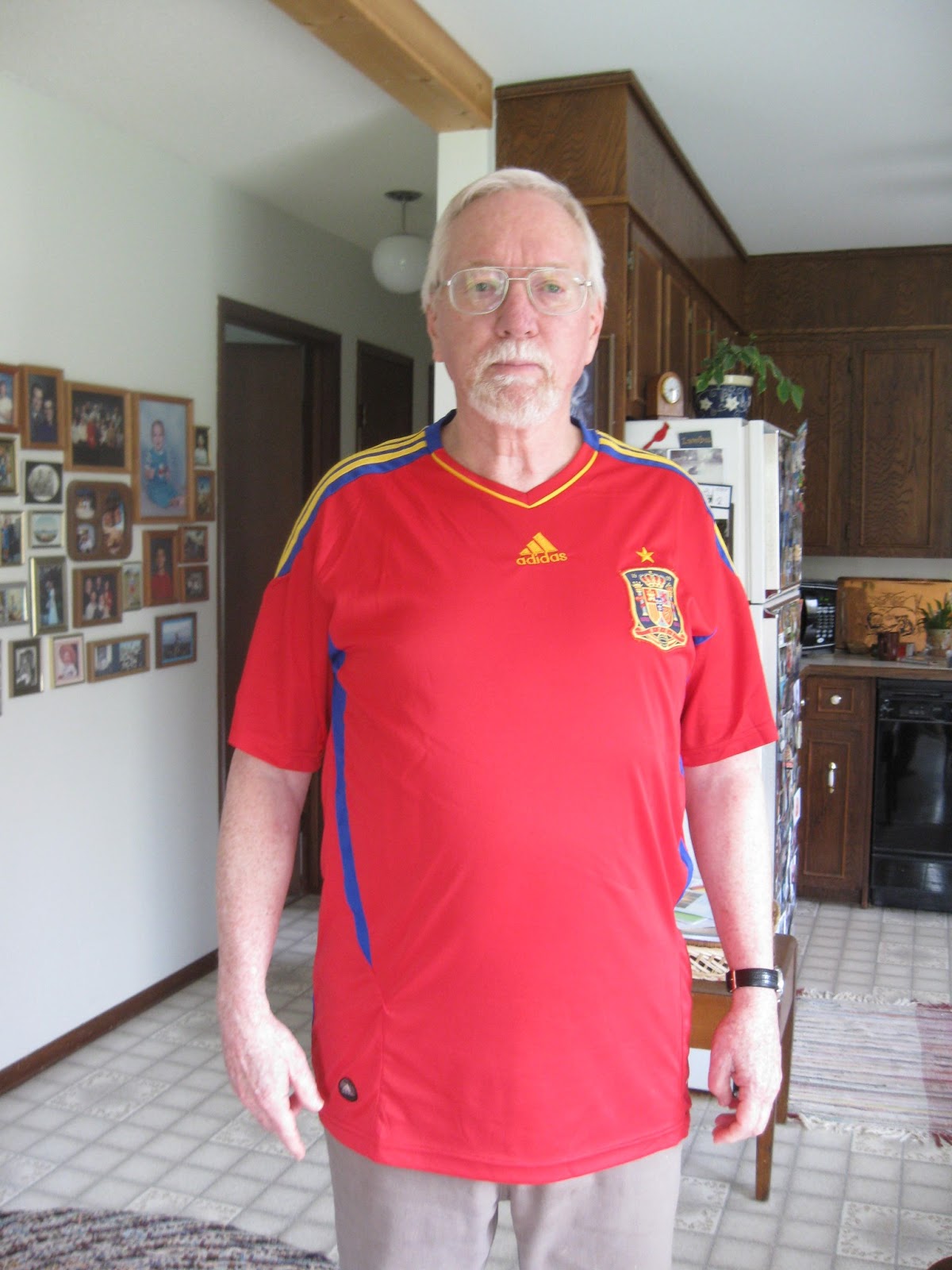
A few posts ago I wrote about my football jerseys (soccer shirts). There I described this jersey:
I wrote about it: "UK 2: Liverpool. Almost my favourite shirt. Gift from Joe, bought in Harare from a sports shop run by the former national coach there. In the 1980s Liverpool’s goalie (one of the best they have had) was a Zimbo who went to the same High School as I did in Bulawayo. You cheer for your old mates, even after they’ve had a whiff of scandal. (Nothing proved!)"
UK Liverpool indeed! People kept asking me if it was a shirt from Spain. I kept saying no, they must look alike. Then my older son searched the net for images and showed me this:
 This is indeed the home jersey for the Spanish national team! The description above remains true--except that the shirt does come from Spain. Not Liverpool. Not even Liverpool, Spain; just Spain.
 
Fortunately I like Spain. I can wear their shirt with pride. I can still support Liverpool and remember Grobelaar (the aforementioned goalie) with pleasure. Now all I have to do is get a shirt that looks like this!

I suppose that I can raise a glass of Carlsberg to the truth.

Wednesday, June 19, 2013

Paul: The First Anabaptist

The title is a bit misleading--trying to connect my Mennonite Church with Paul, when we usually gravitate towards the Gospels. A sermon preached at SMC last Sunday, introducing the Summer Series on "the fruit of the Spirit".

Steinbach Mennonite Church
16 June 2013
Paul: The First Anabaptist
Text: Galatians 5: 13-26
Life by the Spirit
13 You, my brothers and sisters, were called to be free. But do not use your freedom to indulge the flesh; rather, serve one another humbly in love. 14 For the entire law is fulfilled in keeping this one command: “Love your neighbor as yourself.” 15 If you bite and devour each other, watch out or you will be destroyed by each other.
16 So I say, walk by the Spirit, and you will not gratify the desires of the flesh. 17 For the flesh desires what is contrary to the Spirit, and the Spirit what is contrary to the flesh. They are in conflict with each other, so that you are not to do whatever you want. 18 But if you are led by the Spirit, you are not under the law.
19 The acts of the flesh are obvious: sexual immorality, impurity and debauchery; 20 idolatry and witchcraft; hatred, discord, jealousy, fits of rage, selfish ambition, dissensions, factions 21 and envy; drunkenness, orgies, and the like. I warn you, as I did before, that those who live like this will not inherit the kingdom of God.
22 But the fruit of the Spirit is love, joy, peace, forbearance, kindness, goodness, faithfulness, 23 gentleness and self-control. Against such things there is no law. 24 Those who belong to Christ Jesus have crucified the flesh with its passions and desires. 25 Since we live by the Spirit, let us keep in step with the Spirit. 26 Let us not become conceited, provoking and envying each other.

Introduction
This morning we begin our summer series on “the fruit of the Spirit”. Since the list of the qualities in the fruit of the Spirit appears in Paul’s letter to the Galatian churches, we begin with an overview of Paul’s life to show where the letter fits in, and then look briefly at the churches to which Paul wrote.

This gives us the basis on which to look at the point of the whole letter: Paul’s concern that the new Galatian Christians follow Christ, not the Law of Moses.

Within that purpose for the letter, we find this list of qualities: “22 But the fruit of the Spirit is love, joy, peace, forbearance, kindness, goodness, faithfulness, 23 gentleness and self-control. Against such things there is no law.”

Paul
Two years ago I used this outline on PowerPoint to show Paul’s life and where the different letters fit. The outline is adapted from F.F. Bruce, Paul: Apostle of the Heart Set Free, 475

The Life of Paul: All dates are approximate
Date                Church                                               Rome
28-30 AD        Public Ministry of Jesus                      14-37: Emperor Tiberius
5?                    Birth of Paul
33                    Conversion of Saul
35                    Paul’s first post-conversion visit to Jerusalem
35-46               Paul in Cilicia and Syria                      37-41: Emperor Gaius
46                    Paul’s second visit to Jerusalem          41-54: Emperor Claudius
47-48               Paul and Barnabas in Cyprus and Galatia
48                    Letter to the Galatians
49                    Council of Jerusalem (Acts 15)           49: Jews expelled from Rome
49-50               Paul and Silas travel from Syrian Antioch through Asia Minor to Macedonia and Achaia
50                    Letters to the Thessalonians
50-52               Paul in Corinth                                    51-52: Gallio proconsul of Achaia
Summer 52      Paul’s third Jerusalem visit                 52-59: Felix procurator of Judaea
52-55               Paul in Ephesus                                   54-68: Emperor Nero
55-56               Letters to the Corinthians
55-57               Paul in Macedonia, Illyrium and Achaia
Early 57          Letter to the Romans
May 57            Paul’s fourth Jerusalem visit
57-59               Paul’s imprisonment in Caesarea
September 59              Paul’s voyage to Rome begins            59: Festus succeeds Felix as procurator of Judaea
February 60     Paul’s arrival in Rome
60-62               Paul under house-arrest in Rome        62: Death of Festus; Albinus procurator of Judaea
60-62               Captivity Letters (Colossians, Philemon, Ephesians, Philippians)
65                    Paul visits Spain                                  64: Fire of Rome
65? (68?)         Paul’s death

Note that many commentators place the letter up to 10 years later, at the same time as Paul’s letter to the Romans. There are similarities in the theology of the two letters that support this suggestion, but I think that an earlier date is more likely correct. I just finished a set of essays on Galatians that suggests 52 as the date and makes some convincing arguments in support. This date makes the most sense to me, so that I don’t follow completely Bruce’s dating on the chart.

Why does this matter? The controversy of "the Council of Jerusalem” in 49 sets the stage for this letter. Some people came to the mother church in Antioch (representing themselves as from James, the leader of the church in Jerusalem) and effectively tried to negate the implications of the Jerusalem Council. Paul hears about their visit as he works with the church further West in Corinth or in Ephesus. He can’t get back to Galatia, so he writes this letter to make sure that the gospel accepted in the Jerusalem Council is not lost.

Paul’s gospel—the gospel of Jesus Christ—centres on the person of Jesus Christ and sets aside the Law of Moses as the way of salvation. His opponents wanted to retain the Law. Before the Jerusalem Council they tried to keep the Law as the way of salvation, with Jesus as Messiah for those who follow the Law. After Jerusalem they tried to make the Law the fruit of salvation, which real Christians would follow once they came to Christ. Paul sets the Law aside. He calls it “a schoolmaster” (KJV) or custodian (NIV), whose task had been to bring people to Christ. Now that it has done so it falls away, fulfilled in the person of Jesus Christ. This is why I call Paul “the first Anabaptist”. His great concern in life was to know Christ and follow Christ and to live Christ. He says, “Imitate me as I imitate Christ.” The first Anabaptists were similarly focussed on Christ. We can learn from Paul as he worked out the meaning of a Christ-centred gospel in his own life.

The Galatians
Paul’s first missionary journey: Paul and Barnabas sailed to Cyprus and then on to the coast of modern Turkey, that part of Turkey known as Anatolia. On the map it includes the cities of Antioch, Iconium, Lystra, and Derbe—cities in South Galatia. The political centre of the Roman Province of Galatia is north of this journey.

The commentators differ as to which churches are meant by “the churches in Galatia” (1:2). Some say that these were congregations in one of the cities mentioned in Acts and shown on the map. Others note that Paul refers to ending up in these churches because he fell ill and was forced to wait there for a time (4:13), and suggest that they were in North Galatia—probably several congregations in one of the North Galatian cities. In that case, the trip is not mentioned in the Acts of the Apostles.

In either case, the people in this church were Gentiles by background—“Galatian” is a Roman form for “Gauls” or “Celts”. If you like, they were Welsh folk who emigrated ac ross Europe to Anatolia and had settled there some 300 years earlier. They were attracted to the teachings of Judaism, and accepted the gospel of Jesus Christ gladly when Paul was laid up with illness and spent time with them.

The Message of Galatians
Although they accepted the gospel of grace gladly, when the Judaizers showed up, they were attracted to this new teaching. The idea that they could go deeper into the Christian life by keeping the Jewish Law—which in this case meant especially keeping the dietary requirements (2:11-13)—appealed to them. They thought that the difficulties of what it means to follow Christ could be resolved if they could just keep a kosher table like the Jewish Christians told them to.

Paul recognizes that this move would undo all of the good that had taken place in the Jerusalem Council. Before the Jerusalem Council some thought that Jesus the Messiah was the path to life, and others held that the Law of Moses was the path to life. If the Galatians began to smuggle the law back into the gospel, Paul could see that the long-term result would be to extinguish the gospel of God’s grace available in Jesus.

In the chapters preceding our passage he advocates for a Christ-centred gospel in a variety of ways. And then in this passage he addresses a problem that some people had when they heard him speak. If the Law is fulfilled and no longer applies, they said, we can do anything we want! Some people in the Corinthian churches understood Paul exactly this way (1 Cor 6:12): “I have the right to do anything,” you say—but not everything is beneficial. “I have the right to do anything”—but I will not be mastered by anything.

So Paul makes it clear. Freedom in Christ means freedom to become like Christ, not freedom to do anything we want. “The works of the flesh” (5:19) are the kinds of things that someone who is completely self-centred does. The fruit of the Spirit (5:22) are the qualities of someone who is becoming like Christ, putting on Christ, set free from the tyranny of self to be filled with the Spirit.

The Fruit of the Spirit
Over the next two months we will spend time on the different qualities found in the fruit of the Spirit. We will discover what the likeness of Christ is, into which we grow. It remains to make one last point this morning. You notice that Paul calls this thing, whatever it is, “the fruit of the Spirit”. He does not say “fruits”—the fruits are; he says “fruit”—the fruit is. Does this matter? I used to be an English teacher. Is this just a grammatical fine point that really is not that important? I suggest that accuracy is important.

I saw a picture of a sign in a store advertising a spray: "Roach and Aunt Killer" “Roach and Aunt Killer!” Just a little “u”. It doesn’t make any difference! At least I’m glad I’m an Uncle, so that no one sprays me with the stuff to get rid of me.

Or again, the saying, "A woman without her man is helpless" changes meaning if you add punctuation--"A woman: Without her, man is helpless." Don't worry about the political correctness of either sentiment; The extra punctuation marks change the meaning completely! Accuracy does indeed matter. Paul said “fruit”, and there’s a good reason for it.

Compare the way that Paul talks about gifts of the Spirit. In 1 Corinthians 12 Paul writes: “Now about the gifts of the Spirit, brothers and sisters, I do not want you to be uninformed.” He uses the plural because different gifts are given to different people. No one person is expected to have all of the gifts. We have them all together, as the body of Christ. That’s part of what makes each of us valuable within the body—we’re needed because we have different gifts. Nobody is expected to have all of the gifts. You might have two or three, but you and I depend on each other to have them all.

But in our passage Paul writes: “But the fruit of the Spirit is love, joy, peace, forbearance, kindness, goodness, faithfulness, gentleness, and self-control.” Paul uses the singular “fruit”, because there is only one fruit. There are various ways of describing it—love, joy, peace, forbearance, kindness, goodness, faithfulness, gentleness, and self-control—but there is only one fruit. Therefore a part of Christian maturity is to grow into all of these qualities. You can’t say, “I don’t have the fruit of love, because that’s not my fruit.” They are all “my fruit”.

The importance of this truth is to remind us that we all have more growing to do. Jake Loewen—MB missionary and anthropologist from BC—tells how near the end of his life his Uncle Walter (his mother’s brother) came to visit Jake and his wife, Ann. Uncle Walter asked Jake, “Tell me, what is the most important lesson you have learned in life?” Jake replied, “Obedience.” His Uncle said, “That lesson I have learned.” He turned to Ann and asked, “And what have you learned?” She replied, “Love.” Sheepishly his Uncle said, “That lesson I have not learned. I haven’t even learned to be höflich [polite]. If the good lord wants me to learn to love, he will have to recycle me.” Jake observed that he himself, although over 70 as he wrote these words, was also trying to learn the lesson of love. As we consider the qualities in the fruit of the Spirit, I trust that you and I will see places where we can still grow, and that we will open ourselves to the Spirit of Christ more fully to make us like himself. The alternative is to follow the Law and try to do it all ourselves. That way is despair and death. The way of the Spirit is freedom and life.