Monday, March 12, 2007

That Car


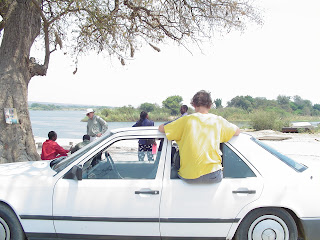
This is a car. This is a car to remember. When we arrived in South Africa (August 2003) we had three days to get a car and head north to Bulawayo. We went to a car dealer recommended by a friend (without whose recommendation we would indeed have been stuck): the car above was the result. A 1988 Mercedes Four-door Sedan. Looked wonderful. Wasn't.

We made the mistake of setting the amount we thought we could afford, and bought a car for that amount. We sold it when we left in December -- back to the dealer for close to the original price. It all worked out in the end, definitely a better deal than trying to hire a car for five months. But oh my goodness, what a car!

I could write about the roads instead. We travelled over good tar roads and rough dirt tracks. We drove from Johannesburg to Gaborone to Bulawayo, then north to Livingstone and Choma. We drove back south through Botswana to Jo'burg. Then 16 hours West to Windhoek, out to Swakopmund, and back to Jo-burg (but going the long way round. not through the desert this time). So we made the car work.


At first it seemed like a good deal. Nevin wrote in an email that we could never afford a car like this in Canada. Later we could add that we wouldn't want to. Driving north to Bulawayo went okay: we had cruise control and air conditioning. The car was a bit sluggish, but not bad. After seven weeks in Bulawayo we headed north -- 280 miles to Victoria Falls. And the trouble began. We had had new brake pads put in while in Bulawayo: they squealed the rest of the time we had the car. But far worse was the petrol (gas) problem.


We were half way to the Falls when the car lost power and coasted to a stop: quite a helpless feeling on a relatively deserted road in a country with almost no fuel. we looked at the motor, not knowing what we were looking at, then Vaughn and Nevin wondered aimlessly down the road to look at the road and the trees. Within five minutes a car appeared -- a couple with their daughter, on their way back from taking pictures of animals. He was a naturalist-photographer. More importantly, he showed me how to open the fuel line, blow into it to clear it, suck on it to get the petrol flowing again, and replace the line. I did this about 10 times between that first stop and the Falls. We stopped in Hwange, the only town between Bulawayo and Vic Falls, where they blew out the fuel line with an air compressor. Didn't work.

The Falls deserve their own post: enough to say that no human problems with running a country can dim its glory. It truly is an amazing sight. Lois and I had a cup of coffee, while Vaughn and Nevin went to watch the sun set through the spray and haze on the south side of the Falls. At sunset we crossed into Zambia, car and all.

The experience led to a surreal exchange with the Customs Officer at the Zambian border. "This car is registered in your name." "Yes." "But you are a visitor in South Africa." "Yes." "But the car is registered in your name." "Yes" "But you are a visitor in South Africa!" "Yes." I don't know how many times we repeated this; it evidently bothered him. I felt like saying, "That's their [the South Africans'] problem; don't worry about it", but managed to say nothing. Finally with an expression of disgust he stamped the papers and sent us on into the Zambian night.

We were headed about three miles into the country to a well-recommended collection of rondavels, where we planned to stay the night. About a mile short, the car stopped again, and I fiddled in the dark to try and clear the fuel line. Then a pick-up arrived, with load of helpful Zambians on the back. They clustered around, pushed me aside, and fiddled less expertly than I (but with the lights of the pick-up shining on the motor). Then one of them bumped a plastic piece attached to the radiator, snapping it off and spraying hot, hot water everywhere. By the time we had given them all the loose foreign exchange we had (US$5 and 100 Rand) for their help (I use the word loosely), we felt frazzled and limped into the Rest Camp.

The next day I nursed the car on into Livingstone, where a garage owner located a replacement for the broken piece (ordered and then rejected by a local Merc owner!) and drilled a hole in the petrol tank cap (to let air in so that it wouldn't stop on us -- brace try, but wrong answer to the problem). Then we headed on to Choma. Half way there we were able to verify that the fix didn't fix the problem.

In Choma, the mission mechanic (Given Mweetwa: pictured at the top of the blog) spent his off-day -- eight hours on a Saturday -- diagnosing and fixing the problem He replaced the fuel pump: that wasn't it. He then removed the petrol tank through the trunk and found that the filter at the tank was so rusted as to let very little through. He cleaned the filter gently with a toothbrush and paraffin (kerosene), since there were no replacements here in Choma. And that problem was fixed. All the way back to Jo-burg.


In Johannesburg we had a mechanic give the car a thorough over-haul. What he didn't know was that our tires were bad. We had two flat tires on the way to Windhoek -- the second about an hour from the half-way Rest Stop at Kang. As we sat, watching the sun set and knowing we were stuck in the desert, a big new Merc truck pulled up, and picked up our luggage and tire and us and took us to Kang. I got a tire sent up from Gaborone by country bus (no Merc tires there: special order only), had the tire put on the rim, and got a ride back to the stranded Merc. Soon after Lois heard me and Vaughn come driving in: she heard us before she saw us thanks to our squealing brakes.


The next day we set off for Windhoek (day three of what should have been a two-day trip). About an hour out of Kang I stopped to check the tires. They were fine, but when I tried to start the car there was nothing. General electric failure. I guess the Jo'burg mechanic didn't find everything. We should have realized we were in trouble when we entered the Kalahari two days earlier. The air conditioner gave out, and the heater came on. We couldn't turn it off, so we drove through the desert with the heater on, pointed out the open windows -- our contribution to global warming.


Pushing the car didn't work. The first vehicle that came by did what they could, but no luck. The next car by was headed towards the Rest Stop. They took me back to Kang. When I walked in the owner looked at me and said: "What are you doing here?" I said, "General electrical failure." He found an electrician, and provided us with a jeep to take the electrician back to the car, where Lois and the boys waited. They had five hot hours in the more than 40 C (104 F) sun.

There the electrician re-did the connections to the battery, rewired the alternator, and bridged three fuses that had blown out. We had our air conditioner back! We gave him all the Pulas (Botswana's currency) we had left, and headed off for Namibia. When we found a proper garage, we had all of the work re-done, and in Windhoek spent another 2,000 Rand on repairs so as to drive safely back to Jo-burg. But I never did quite feel safe after that.

One can draw lessons. In our time in Bulawayo 1988 to 1992 we drove mission vehicles -- all paid for by the church. This time we experienced life more like many residents of Zimbabwe and southern Africa, driving what we could get. We also discovered how ready people are to help. We never waited more than ten minutes for help, although we were in unpopulated areas. The Kalahari is not where you want to break down!

I remember Nevin's comment in another Rest Stop the evening after the general electrical failure. With five hours waiting in the desert, and another three hours driving to the Rest Stop in Namibia, where we stayed that night, we had finished all of the water and other drinks we were carrying. Just before we went to bed, Nevin said: "You know where Jesus says, 'I'm the living water'': I think I understand better know what he meant."

And I remember the car. Next time we won't ask, "What can we get for this amount of money?" We'll ask, "What does a reliable vehicle cost?" The memories are good, but I don't want to repeat them.

Tuesday, March 06, 2007

Memories of Zambia

October 2003 we made it into Zambia, for one short week. Far too brief a time, but it was good anyway. The country, or at least the geographical place where I was born. We entered at Victoria Falls and drove the few miles from the border to Livingstone, where I was born so long ago.


The car was packed, and Vaughn wasn't the only one scrunched up to fit. The driver (me) had the best deal: at least until we had fuel problems and I had to get out every ten minutes or so to clear the fuel line (unfasten fuel line, blow in, suck out, try not to get any fuel into your mouth, get back in car and drive for another ten minutes).


Soon enough we were rewarded with a chance to view the Falls -- the evening we arrived, from the Zimbabwean side; the next morning (while our car was worked on, but not entirely repaired) from the Zambian side. Here is a rare pose from in front of the Falls (Zambian side here) -- rare because he became our family photographer for the trip.


As we got further into Zambia, we saw the jacarandas. We had been too early for them in Bulawayo, but here they were in full bloom. We only had to stop twice over the 120 miles to Choma to clear the fuel line (the car's and mine). At one of those stops we took a picture of the jacarandas: introduced by White settlers, these trees are gorgeous, but also greedy. They drink up too much water in the semi-arid conditions of Zimbabwe. During good rainfall years in Zambia they are welcome.


In Choma we stayed at the missionary guest house (just as in Bulawayo, but more modest than the former children's hostel: space for six to ten guests instead of 20 to 30). Lois and the boys went into town and found (among other things) this tailor working on the side walk. They brought him some material, and he made shirts for the boys, which they have worn with delight many times since.

Nevin also searched in Choma for a good drum to take home. He had checked in Bulawayo for a good drum, and learned that the best drums came from the Tonga in Zambia. We found one near the end of our stay the a cultural centre in Choma. That drum had its own adventures later.


Then it was off to Sikalongo. The 20 miles I remembered were not accessible for a car, so we went around, about 30 miles instead. We had trouble finding the run-off from the tar road on the track that crossed the final six miles or so to get to the mission and school, my first home. So we stopped and I asked directions. My parents tell me that when I was three I had some Tonga, but I can tell you that at 53 my Tonga consisted of "Hello" and "Thank you". The people I talked to did not have much English either, but we managed, and we found the road to Sikalongo.

There of course lies a grave. Dorothy. My sister, who died before I was born, and has always been part of my consciousness.


I discovered a curious thing at Sikalongo. My parents, uncle and aunt, and grandparents have all lived in Zambia or Zimbabwe at different times. Our family is known well enough throughout the Brethren in Christ Church there. When I would say my name, I was always identified as part of my family: walking like my grandfather and father, and with the red hair of my uncle.

But at Sikalongo, when I met the headmaster of the secondary school and said my name, he said: "Oh yes. Your parents were David and Dorcas Climenhaga. Your sister is buried there." And he pointed across the schoolyard towards the cemetery. One of the teachers took us for tea (actually, Fanta orange and cake) in his house. He told us that his brother had lost a child the year before, and that they used the same verse at that funeral: Suffer the little children to come unto me.

Back in Choma, then, it was little surprise to meet a 10-year old boy named Climenhaga Hamaseele (son of the Overseer for the church in Choma). The effect of leaving one's own flesh and blood in the ground has a powerful impact, even after 55 years. There, in that place, I was with people who remember my mother and father, not just the rest of the family.


The week was over. We headed out of the country, but this time crossing the Zambezi at Kazangula instead of at the Falls (and so avoiding Zimbabwe on our way back to South Africa). There was no bridge into Botswana, so we crossed the river on a ferry. Our confidence was not increased by the news that a couple of weeks earlier the ferry had been overloaded with passengers, turned turtle in the water when a badly-loaded truck drove on to it, and drowned about 100 people. Of course I was the one to drive our car onto the ferry -- and me with me water phobias! The authorities carefully kept all passengers off (of which this time there were only about 20).

So we crossed the Zambezi, entered Botswana (drum and all), and left the land of my birth. So short a post omits watching Vaughn and Nevin play soccer with young children at the guest house, struggles with the car (to which I will return in the future), church in Choma, so many things from my home. I keep a flag of Zambia in my office, remembering the land where I began life on this earth.

Monday, March 05, 2007

Memories of Zimbabwe

I have decided to continue the process of recalling our sabbatical, June to December 2003. I say "our" (although it was technically "mine") because this was a last intentional family trip: Vaughn (then 21) and Nevin (then 17) joined us in a trip back to south and south-central Africa, so formative a part of my own growing up, as well as for our family.

While we were in Bulawayo we stayed at the Guest House, where years before there had been a children's hostel. It was both a delight and a bit surreal to live where I had lived in the 1960s.


While we were there we learned to know Mrs. Shumba. She had lost her home -- evicted for not paying the last $100 or so on her mortgage. She had cataracts and was almost blind, and had ignored the warning notices. (Long story: that's the short version.) She stayed at the Guest House while looking for a new home, and she and Lois became fast friends. Here she is singing with her children (who were part of a group called "Divine Appointment"): "Thula Sizwe" -- a song by Freedom Sengwayo, to comfort the Ndebele people.

We drove out to Matopo Secondary School, where I had lived and taught in the early 1970s, and where our family lived in the late 1950s. Matopo is deep in my consciousness: the place where I used to climb rocks, teach school, try to understand what it is to become an adult.
Elephant Rock is on the way to Matopo. Remarkable rock with remarkable resemblance to the elephant. Ndlovu. Over half of the 3000 acres of Matopo Mission is granite rock above the ground. This is just one of the rocks, so engraved in my memory.


We drove to get around. We bought a Mercedes Benz for what we could afford: wrong car for driving around Africa! Here a someone who worked for a local businessman siphons petrol into the car -- the only reliable source of fuel in a country where the economy had once been so strong. You could still get what you need in 2003, but foreign exchange helped. I could write many stories about this car, and may yet. But here the petrol is the problem, not the car. It managed its way out to Matopo and back, although the roads were so much worse than they had once been. In the late 1980s we could drive out easily. in 2003, the 30 miles took about two hours of careful driving around potholes and following the occasional tire tracks beside the road instead of in it.
We also re-connected with Mike and Lyn Burgess (third generation Zimbabweans). Mike and I taught together at the Theological College of Zimbabwe (1988 to 1992). He and I are age mates. We turned 40 together in 1990, just a few months apart.

Here he is 53, as am I in the picture below. Life in Zimbabwe is hard. Combined with health problems, it makes Mike look so much older. I noticed that many of my friends in their 40s and 50s had grey hair. Had I seen one or two like that, I would put it down to their genes. But so many: life in Zimbabwe today is hard.
Kyle is standing with them in the picture -- 16 years old. Now four years later he lives with us in Manitoba, going to school at Providence. A small chance to find a life beyond the loss of opportunity in Bulawayo.

I'm standing beside my house, or what was once my house. Two pictures from 30 years apart. Left: during our visit in 2003. Below: when I taught at Matopo in 1974. The house has changed a bit, but not as much as I have. Except that I don't feel all that different: married, children, a whole different life; but the same essential person inside.
It was so good to be in Bulawayo and to visit the Matopos. The beauty remains; the people are wonderful, amazingly strong and resilient. Click here for the sound of the region beyond the pain, or here for a website maintained by the Ndebele people in exile. But the country is also full of pain. After six weeks, knowing we had only a week left, I told Lois I didn't know if I could stand another week. And our friends there have endured almost four more years. Some wounds are too deep to talk about.

Wednesday, February 28, 2007

Sabbatical Remembering


Finding and inserting a picture for my profile sparked memories: the picture shows me waiting for Lois to come out of one of the many delightful little shops in Swakopmund, Namibia. The sign on the bench reads: "Bored Husbands": delightful! We visited Swakopmund during sabbatical in 2003, just over three years ago now. Amazing how quickly three years have gone by.


I could write about many parts of that trip -- time in Bulawayo with inflation beyond understanding; the trip up to Victoria Falls and then on to Choma, car sputtering all the way; driving out to Sikalongo and seeing Dorothy's grave; the full day that Gift (the mission mechanic) put in to get the car running again; back down through Botswana along country that looked and felt like a hot, hot Manitoba; from Johannesburg through the Kalahari to Windhoek (two breakdowns, and five hours in the desert sun waiting for relief); back to Pretoria for another month (with an office at UNISA and living at the Operation Mobilization headquarters); and finally Cape Town. Five months of stimulation: mental, spiritual, family, academic.


But Swakopmund. We drove from Windhoek through more desert, of which much of Namibia central and south appears to consist. The countryside moved from dry underbrush to sand and rocks, progressively dryer and bleaker. One had the sense of a moonscape (as part of the area is actually called). This link gives the official Namibian Tourist Board's description of the area.


Then suddenly, Swakopmund. Water, palm trees, delightful German village on the beach of the Atlantic Ocean. The dunes south of the town had sand-boarders, as well-practised as any snow boarders in western Canada.


We climbed dune seven: well, Lois, and Vaughn, and Nevin climbed the dune. I waited in the shade of the trees, which were being gradually engulfed by the dune. We saw signs on the road warning of drifting sand, with sand plows designed like snow plows in Manitoba to keep the road clear.


And next to all of that: the ocean. Spray and rocks and swell after swell rolling in. Vaughn stood a little too long next to the rolling swell, and one wave drenched him completely as it broke on the rocks. Lois found a pile of rocks facing out towards the ocean, screened from the desert behind, which she pronounced her own secret spot to sit and watch the waves. Whether eating supper with the sun sinking into the ocean, or walking through the shops of this little German community buried on the south-west coast of Africa, or talking to travellers in the backpackers' hostel where we stayed: we enjoyed Swakopmund as an unexpected treat in the middle of five months of a true sabbatical.


Monday, February 26, 2007

Blizzard!

I know the title is overdone, but I drove down to Thief River Falls on Saturday evening. About 40 minutes out of Steinbach, and 15 minutes north of the border, I found myself in white-out conditions. I knew that there was a winter storm watch on; but I had driven into Winnipeg in the morning under the same storm warnings without difficulty. So it was with some dismay that I found myself driving deeper into blizzard conditions, not sure of where I would end up.

I preach in Thief River Falls about once a month, driving down Saturday evening and back on Sunday afternoon. I could have -- perhaps should have -- called Mel and said: "I can't make it. Sorry!" But I kept going straight. Out on the prairie it is easier to go straight than to turn around: through Rouseau and Tolstoi, on towards the border.

Homeland Security soon decided that this strange traveller, emerging from the blowing snow into the relative comfort of the border crossing, was no threat to the United States and could be allowed in. I had no desire to go back into the blizzard immediately, so engaged them in conversation about the weather -- and the possibility of accommodation in Lancaster, 10 miles down the road. (I knew the answer: none; but I thought I might stay with someone from a church I have preached for there.)

Half way from the border to Lancaster the blowing lifted a bit and I was left with a half hour of daylight and steadily falling snow. But now I could see the road, or at least the stubble on the verge, which showed me where the road stretched out ahead. I pressed on to Karlstad, where a motel offered some possibility if Thief River was just too far. Following a stop at the convenience store in Karlstad, I decided to press on to Thief River: the last 35 miles took another hour. Total travel time: four hours; normal time from Steinbach to Thief River: two hours and a bit.

When I got into Thief River at 8:30 in the evening, my host informed me that Mel (the associate pastor where I was preaching) had just called to say that the services for the next day had been cancelled and I could go home. Right!! I was relieved to discover that this announcement was a bit of prairie humour. Garrison Keillor would have approved.

Following two services the next morning, I drove back to Steinbach -- only two hours and 45 minutes this time. I also had a lecture to give Sunday evening in Winnipeg, with two more hours there and back and two and a half hours of lecture. So, a tiring weekend, but I am so grateful for safety. I have often said that I prefer blizzards to tornadoes, because you can't really avoid a tornado, but you can always stay inside in a blizzard. I should learn to listen to myself sometimes.

Saturday, February 17, 2007

Happy Birthday, Donna!

I know your birthday was a few days ago -- five years older than I, all our lives. It took me until now to get these pictures that mother had put in an album for me (she may have given you a similar personalized set of your own: I don't know).

So for your birthday present, here are some memories!

Love, Daryl


Mother's label: "Daryl and Donna": although of course it is Donna and Daryl


"Donna and Daryl in Pretoria, S. Africa"


"Sikalongo Mission"


Donna--Daryl--Mother--Macha Mission


"Bulawayo Park--1953"


"Leaving Choma, Zambia--1954"


"In Cherbourg, France--1955"


"On Queen E, 1954, January"


"Bulawayo Park--1958"


"Family--1957--December"


"Bulawayo Park--1958"
No label, but it must be around Christmas 1974.
Back: Daryl, Donna, Carlin, Denise
Front: Mother, Geoffrey, Dad

Monday, February 12, 2007

World, Country, Family, Church?

I have pursued the idea of community in several posts. As I write, my thinking clarifies: sediment sinks to the bottom (I hope I never have to dig around there!), and a somewhat clearer brew rises to the top. I think I'm starting to get it.

I have taught often in my classes that our emphasis on individual fulfillment, basic to our identity as North Americans, is detrimental to the larger community to which we belong; and I believe i am right. But I am also a child of the Sixties. I desire the right, at least for myself, to determine as much of my present and future as I reasonably can, and I can't see any good reason to deny anyone else the same privilege. "All the world, so easy to see, people everywhere just got to be free."

So I face a basic fact: I am committed to the same individualism that I find destructive of community within our society as a whole. I am also a child of my own culture. Africa has taught me that we are most fully human within community: umuntu ngumuntu ngabantu (a person is fully a person with other people): but I am an American anyway.

This note of community lies behind my embrace of Penn State fight songs. It is the force that binds me to my countries, however frustrated I am with what we do as Americans or Zimbabweans or Canadians. It is the commitment that keeps me human within the whole human family.

I thought of this all again most recently in the aftermath of a church discussion. I grew up Brethren in Christ, and that church identity is deep within me. My grandfather's grandfather's father was a lay minister in our church, in Ontario in the early 1800s. But after this particular conversation, I felt so annoyed as to wonder if I should embrace my Mennonite identity and leave the Brethren in Christ behind.

The answer is, of course: No. Asking the question also answers it. As I have said on various occasions, the hardest part of moving to Manitoba has been the fact that we have moved out of the geographic orbit of the Brethren in Christ Church. I have sometimes wished that we could have remained as a family within the church, rather than having to find a new Mennonite identity (however closely related our faith communities are). As soon as I raise the possibility, I know that I could not do it: my extended faith family is too much a part of myself to leave it behind.

If I had to rank the communities within which I find myself, I would place church and family together -- in practical terms, family (since one lives most closely with family), but the two hardly separate. In the second rank, I would place country and the whole human family -- again in practical terms, country (since one lives first within one's country), but again the two hardly separate.

I find myself, I find my fulfillment, within the various communities in which I live: worldwide, country, church, family, and work. (I notice that the workplace has not figured in this narrative: perhaps because so much of my work life has been in the church, and now continues in a seminary, I tend to equate work and church.) Umuntu ngumuntu ngabantu.

Friday, February 09, 2007

Valentine's Day Is Coming

Valentine's Day is coming. I know because WITF (accessed by internet) told me so. I always have trouble remembering which precise day is Valentine's: I know that it is on one side or the other of February 13, because I know my sister's birthday.


I'm not sure what the day is for really. In Manitoba it marks a necessary break from the deep freeze of the True North Strong and Free (and cold). Perhaps most fundamentally the day is not so much for lovers (at least that, of course: but so much more) as it is for family. In our case, lovers and family go together.

I remember coming back from Zimbabwe 32 years ago. People asked what I hoped to do, going home (wherever home is) after three years teaching at Matopo. I gave various replies, including, "Get married". I look back and wonder at my naivety, the audacity to think that one could simply look around and find someone and "get married". I did. Mother invited three young women to lunch, all from our church, all with connections to Africa, students at nearby Goshen College. I already knew all three, but over time drew close to Lois. I remember playing the romantic lead in "Brigadoon": the director and cast were convinced that Laura and I would take our on-stage roles into off-stage romance. But there was Lois, and in July 1977 we were married. She was and is my only romance.


I think of another romance, so many years ago. John and Emma, written up by my sister. A story bracketed by two walks: the last along the same railroad track as the first on the day before she died. They remembered how so many years before John had clambered down the embankment to pick a flower which she admired. Our father's parents, romantics in their own way.


Then David and Dorcas, our parents: together a few months less than 50 years, until mother died. On this day it is hard to believe that was almost 16 years ago. Their courtship was long distance, both in geography and in time. My memory (which of course only covers the stories I was told: I was not present) says that they were engaged for three years. If I am wrong, I will be corrected!


I wish I had the story also for David and Cora, mother's parents. I know only that this young man from German background connect to the Brethren in Christ married a young girl, also from German background, but Lutheran; so that she gave up jewelry and fancy clothing to marry him and join the Brethren.


Lois' parents? Alvin and Maxine Heise: engaged before World War Two, but married after. In the weeks before Dad's death he and mother described their courting and early family life. Dad grew up on the farm in Kansas; so did mother. They were to take over Grandpa Heise's farm when they got married. But World War Two came; the draft board refused to give him an exclusion for farming: that went to his father. But Grandpa Heise's health was not good enough to keep farming. During the war he had to sell the farm, and when Alvin and Maxine got married, the farm was gone. So -- as a second best alternative to farming -- Dad went to medical school, became a doctor, and practiced family medicine for 30 years in the same small town in Ohio. I always assumed that he chose medicine first. but he and mother meant to farm.


Today we have sons: four of us. Valentine's Day includes them. We have a fifth too -- a virtually-adopted son from close Zimbabwean friends, but he took the picture. Romantic Love (eros), Family Love (storge): we celebrate all kinds of love. (Eventually I'll add love of pets: our dachshund, Fritzie, is a member of the family.) I said a few posts ago that we show our love for humankind in our love for our country -- that's the beginning of community; I could add that family is the best laboratory for community. At least, it has been for me.

Friday, February 02, 2007

Sitting By The Window

Lois and Kyle have taken over the television downstairs, watching some movie that takes off on The Taming of the Shrew. My tolerance for movies is low: give me Pink Panther movies or The Court Jester, and I'm happy. (There are of course a few other exceptions.) But in general movies play too strongly on my imagination, and I find it easier to leave the room. Years ago (15 or more), Lois and I went to see Dead Poet's Society in Bulawayo. I have never gone so often to the lobby to buy popcorn, to the washroom for a break, anywhere to avoid the tension I felt watching the actual show.

So I am upstairs, looking out the window at the snow sparkling in at minus 30. More than crispy! Sparkling like diamonds! In the background a vinyl record plays Bach's Goldberg Variations on the harpsichord. A pile of unsorted papers waits beside me for attention, once the blog is done.

One could almost imagine that the world is right, sitting by the window with the bitter cold so close, and so far away. Today another report came on the imminence of a world less pleasant to live in: climate change. It seems far away behind the crisp, crunchy snow; but it is also intensely real here in the North. Winter roads in the far north are now back on schedule, but they were delayed again this year by the lateness of the deep cold of winter. Further north in Churchill, the polar bears walk through town, seeking restitution for lost habitat.

The moon is remarkably bright tonight. Almost one could imagine snow blindness after the sun goes down! Looking in my window I can almost hear the moon ask why we take the environment so lightly, so much for granted. I have no answer. Nor, I think, is there one. Sitting by the window, the bitter cold so close and so far away, fading into the past.

I am a Christian. I believe in God the Father Almighty, maker of heaven and earth, and in Jesus Christ his only Son, born of the Virgin Mary .... The Apostles Creed and climate change war within, and both speak of sin and salvation. I wonder when it will come.

Sunday, January 28, 2007

A Larger Community

So I keep chasing the idea of community. I'm pretty well convinced that the pursuit of individual fulfillment is inimical to community: even while I seek to do that which is fullfilling and significant. I see also a basic problem with the anti-authority binge baby boomers (me!) did so well. (I took a personality test on the Piaget-Kohlberg stuff once: scored as making decisions on principle, rather than legalistically: felt really good about it! Then the test asked one last question, which revealed that at least some of my oh so principled choices were actually just a manifestation of my distrust for authority. Ouch!)

So, along with a life lived protesting government actions and the seemingly arbitrary decisions of church and business authorities (to name only three sources of dissent), I find myself arguing that we need the community that come from patriotism and school spirit and general commitment to the larger group.

Are there any conditions? Should we just commit to the larger group and then look for the utopia to follow? We need at least one larger commitment: to the human family. As a Christian I subsume this commitment within my commitment to God; but speaking in purely human terms, speaking simply as a person regardless of religious commitment, that person who does not have a fundamental commitment to the good of the whole human family is dangerous indeed.

The point is obvious. If allegiance to a school (since I have been writing about school spirit) were to run so unchecked as to take priority over allegiance to our country, we would recognize it as flawed. If in the name of Penn State one were to fight, and even seek to destroy, supporters and alumni of Pitt, the police would step in and the courts would take away one's freedom.

Speaking as a member of the worldwide community, we have come dangerously close as Americans to acting like such deranged Penn State fans, except with bigger weapons. Perhaps that sense of caution that is so typically Canadian is a necessary ingredient for a truly good patriotism to flourish. I love the USA, and I love Canada: but I love both as part of the whole human family. I call my country to account when we step outside the bounds of being good members of the international community because I love my country, and because it is mine.

In short, to realize community at home, within the context of my larger political community, in the country that is mine own, I am a citizen of earth; I am part of the human family. I am also, and even more deeply, a citizen of Heaven, and believe that only as a citizen of heaven can I truly love my country rightly.

Saturday, January 27, 2007

What Is Community Anyway?

I said some time back that there is something sacred about community. North American society, both in the USA and in Canada, has been on a long trajectory towards individualism, even at the expense of community. My generation (1960s baby boomers) used to talk about dropping out to find ourselves. as though our identity was floating around the world waiting for us to catch up with it and internalize it. Supreme individualism! As I observed a few posts back, Canada has as its central constitutional document The Charter of Rights and Freedoms, based on the value and rights of the individual almost without regard to the larger community.

That is of course an overstatement: the notwithstanding clause, for example, is a tribute to the desire to strengthen community at the provincial level; continuing conversations about "unique societies", whether in Quebec or in Nunavut, reflect the same desire to preserve community. But the stronger force in our society is the push towards individualism, and that force is destructive of human community unless it flowers within a commitment to the larger whole.

The common saying from southern Africa is: "A person becomes fully human in and through community." At some level we all know the truth here: that we need each other. We know also that people search for community insistently, even as it slips away from us. Whether in church youth groups discovering the value of true community, or in voluntary associations (clubs of different kinds), or in immigrant communities that seek to maintain something of their ethnic identity after moving to Canada -- repeatedly we hold on to each other. As we must.

But figuring out what really makes community is even harder than finding it. Because our communities, even our identity as Canadians, are essentially voluntary, people routinely leave community behind: then we wonder how we lost what we gave up. I'm struggling to figure out what this thing really is. I remember reading Bonhoeffer on community: profound (whatever he said), and hard to penetrate.

I wonder if some sort of real final commitment is necessary: to God (citizens of Heaven), to country ("Breathes there a man with soul so dead ...."), to something or someone big enough to encompass our whole life. I don't know: I think it is, but I don't know. I'm pretty sure that if there's anything less at the centre of our lives, the individual will beat the centre by default.

Monday, January 22, 2007

An Individualistic Socialism?

In a casual conversation about the last post, a friend observed that those countries I identify as highly individualistic are also among the more socialist in the world. Certainly that is true of Canada. Canadians expect more of government than Americans do. As another friend said some years ago, "Americans value life, liberty and the pursuit of happiness; Canadians value peace, order and good government." "Good government" sounds like an oxymoron to many Americans, for whom the only good government is less government.

Thus Canadians willingly pay significantly higher taxes than our American cousins -- and expect more from our government, from paying for health care to paying for education.

I thought of this point when I ran across a recent news story, which stated that Manitoba is the most generous of the provinces in terms of charitable giving, but ranks behind 26 other states in the USA. The Fraser institute did the study, and concluded: "Americans gave 1.67 per cent of their aggregate personal income to charity, more than double the 0.72 per cent of the total personal income Canadians donated to charity."

One could conclude that Americans are more generous than Canadians, a view at odds with Canadian self-perception. I suggest that our belief that the government can and should take care of so much (that is: socialism) is at least as important a factor.

In the end these points all revolve around trying to understand ourselves as Canadians. We have embraced the concept of good government, that government has a responsibility to take care of its people. Perhaps a sense of entitlement is one way that this basic socialism coincides with the individualism that is also basic to our society.

Canadians have shown our good qualities in many arenas of our world. But there is a corresponding weakness to our relative courtesy and good neighbourliness (compared to brash Americans). We can be as self-centred as anyone, when we put our minds to it.

I do wonder if we will push back against the forces of radical individualism. We may yet do that. But then we will have to find out what really does bind us together. And in a nation of immigrants, even more intentionally immigrant than the USA, finding common ground is a difficult task.

Friday, January 19, 2007

Committing -- Canadian Style

Part 1 (nothing to do with the title):

I actually typed this post last night, but lost the post through misunderstanding the way tht Blogger works. It is annoying to think and type and reach the point of publish, only to lose the whole. But I have been processing these particular thoughts for a few weeks, so re-writing them is perhaps a good thing, however frustrating.

Part 2 (the actual post):
Some posts ago I observed that Canadian universities exhibit less school spirit than their American counterparts, and that this reticence mirrors the overt patriotism of Americans as compared to the understated Canadian version.

I have asked a number of Canadian friends for explanations, without real success. Like defining what it means to be a Canadian, we are reticent with reasons for our laid-back approach to life. In this context I advance one possible explanation. It is at best partial, and cannot be the whole reason; but if I am right in my diagnosis, it is an important feature of our national character, and source of significant problems in our lives together.

It is a commonplace in the study of culture that Western societies generally have built on the rights and dignity of the individual. The Declaration of Independence in the United States begins: “We hold these truths to be self-evident, that all men are created equal”. We (Americans) have (as I have heard a commentator observe) fought a war to determine whether or not “all men” includes Black people”, and worked through a difficult period we call the suffragette movement to determine whether or not “all men” includes men and women. We have, so far, concluded that the term is inclusive. (For a separate post: the next struggle may be to determine whether the term “all men” means people from all nations, or “all Americans”.)

My own hunch is that Canadian society has taken this emphasis on emphasis on the individual further than most countries in the world. I don’t know who else has gone as far as we (Canadians) have: perhaps some of the Scandinavian countries; perhaps the Netherlands. One the whole, however, I suggest that we have gone further than anyone else, although we are all going in the same direction.

In Canada this emphasis on the individual is enshrined in The Charter of Rights and Freedoms, with its repeated phrasing of “everyone” or “each individual”. One particular product of our Charter rights is the Privacy Legislation, which has worked out in surprising ways in the past years. I teach at Providence College and Seminary. If I ask where a particular student is, so as to give him/her a message, the school is not allowed to answer the question, not even to say if the student is in class or not. The student’s privacy is held to be infringed by telling me where he/she is. One can multiply examples: the depressed patient released from a Winnipeg hospital, which was not allowed to inform his family – even though the patient went out and committed suicide.

In theory, the rights of the individual and the importance of the larger community are held in balance. In practice, I suggest, the rights of the individual generally trump community in Canada. The Liberal Party of Canada articulates this emphasis in the first sentence of its section on philosophy on its web page: “The Liberal Party of Canada believes that the dignity of each individual man and woman is the fundamental principle of democratic society. All political organization and activity emanates from this guiding principle.” In this respect I suggest that all of the political parties are essentially the same, reflecting a radical emphasis on the rights of the individual, unique in the history of human societies.

What does all of this have to do with school spirit, or patriotic fervour? One aspect of a radical individualism is its reluctance to commit to the larger community. I suggest that in this respect Americans are more oriented to the larger community and Canadians are more oriented to the individual self.

There are positive and negative aspects of our national characters for both Americans and Canadians. This reluctance to commit to the larger group within the Canadian psyche is, of course, a matter of tendency only: Canadians have committed deeply in the past, and within every local community many individuals commit to club, to church, to group of friends. But even after I add all the qualifiers, I remain uncomfortable with this piece of my Canadian self: reluctance to commit to the larger community. True enough that American patriotism shows its own dark side in the willingness to follow a leader into military action overseas; but selfish individualism is no cure for misguided patriotism.

In the end, I will continue singing along to “Jerusalem”, and “Fight On, Penn State!”

Monday, January 15, 2007

Kinetic Chaos

Pictures hung in disarray
Long wall with rhyme and reason plenty, but
Pictures hung in disarray

Drainer full of dishes piled
Sink as full, replete with repast past
Dishes piled in disarray

Order fills the greater halls
Chaos fills the tiny walls within
A great grand narrative of order, beauty
A thousand acts of chaos bound by duty
To fill out the Great Hall of
Rhyme and Reason and Rithmetic
My mind, my self fights with overpowering chaos
Scarcely aware of rhyming reason bounding All
Pictures straightened hang on One Great Wall
Dishes done, laid out in grand array
For grander banquet in One Great Hall
“A neat metaphysical conclusion”
Or one piece of flying crockery
One falling picture
Hoping

30 November 2004

Quest

By what right say you are a man?
By whose name do you lay claim
To name yourself?
Whence your authority to hold identity?

I know a man who knew himself
With such clear knowing that we could not speak
Such certainty – Opaque to human eye
Such confidence – His soul I could not reach
When my own self quivers tense, alert
Taut and tensing search and questing
seeking only to know, to find By Whom?

To be a man
To be in Being’s chain
Created
Confused
Caught
At last, knowing by being known

29 November 2004

Thanksgiving 2004

Talk went as talk does
“God bless America, Land that I love”
“Nkosi, sikelel’ iAfrika”
“Breathes there a man with soul so dead
Who never to himself has said, ‘This is my own, my …’”
What citizen are you?
By what right do you hold this passport?
Do you really? Are you – I don’t know
Identity
Card, home, rights, responsibilities
Kit, Mr Fix-It, do it yourself
Who are you? Really – Who am I?

Talk went on, around the swirling mists of
Identity
Mashed potatoes and Turkey
A stew of memories
“King of the wild Frontier”
“Zorro!”
“Have Gun, Will Travel” to rocks bold and old
Climbing, playing, teaching, singing
Mixed together – season with talk and Canada
“This is my home and native …”?

Or something else that all the rocks and grass
All the sea and mountains and people
Can only hint at?

28 November 2004

Sunday, January 14, 2007

The Ball

A ball lies in front of me
Coverless, no history that I know
Hockey, cricket? Some game long past
it may have known. Or not
No history that I know
Perhaps a strong arm blessed it with great force
Or bat became intimate with guided strength
Or stick cuddled it swiftly end to end
No history that I know

A story somewhere, lost with its owner
Now a ball lies in front of me

21 November 2004

No story, no cover, a life on my desk
Links me to the past
It has no story that I know
Yet binds me to my own story
Ball bouncing between outspread bipeds
Young lads in a circle starting a game
Stinger – ball thrown, ball dodged
Bowler to batsman – Howzat!?
A cry I never made, though wanted to
Ball struck left to right
Glancing off defender’s back – into goal
Stories of games from nine to sometime
Lodged in a ball: no cover, no story that I know
Just a life on my desk

22 November 2004

Stages 3

They call me Professor, a strange name
The face in the mirror is the same
But the name, so formal, so filled with distance
Covers the intimate joy of play, joy intense
On field, over board, lost at sea in a game
of life and chance. Professor

One seeks connection
In communion with God
community with God’s people
One seeks meaning
In conversation and silence divine and human and animal
One seeks to be – known and knower
With rank uncovered before our Judge and Lover
More than a rank or title
More than a name or quirk
To be God’s person, named and titled by God

Our forms of address: formal, informal
Do we see with the address beneath the form
To the person meaning, meant to be?
Do I? With my words and deeds
See people with themselves
Ranked and equal, all together
To know by being known

9 December 2004

Saturday, January 13, 2007

Stages 2

A young man I was once
In many places, many ways I -- young
French class, I saw her next to me
That came to nothing
For many years it all went somewhere
And nowhere

A youth in school, on to college
The game more important than
other valuables
Chess and football, Tartuffe stands in the background
identity forming quietly, on the gym floor
over the water cooler, walking with friends

Beneath all else I was and am a child
God's child, child of the church
my God, my church -- known together
Though one so ultimate and the other so dependent
Always together
The church, or God in Christ, carried me
Safe in canoe or woods
Secure in tenement house or apartment
Protected from myself as my own self formed

Young I was once, a young man still
buried in an older body

4 December 2004

Stages 1

All the world’s a stage
And we – you and I my friend
We pass through stages
Acts, scenes, lines
Youth – Family – Job – Security – Retired
Five stages (like good Hindus)?
Seven ages for the human creature?

We stage our set, bit-players rattling and rolling
Rock-climbing: there was a rattle to rock
Lizards and kittens, sinkholes and bells
A fine play worth more than a scene
The curtain call lives in my memory, except
When did the curtain fall?
On board ship, making Neptune’s acquaintance?
On Sadie Hawkins’ Day, afraid of the dance?
Asleep in the woods, car horns blowing?
I know it fell – I remember it well –
But when?

A stage, a scene, a play to recall
Somewhere as a later scene plays on

1 December 2004

Wednesday, January 10, 2007

More on School Spirit/Patriotism

Penn State may be a rousing example of school spirit, especially when you go to a football game. The University of Kentucky at a basketball game would give similar experiences. I have played some of the Penn State fight songs for friends and colleagues here in Manitoba. One of them heard words something like: "We pledge our love and loyalty to thee, alma mater". He said, "Could you imagine Canadian students singing that? They would say, 'I'm here for an education, what are you talking about?'"

He's right. We don't do such school spirit north of the border, just as we don't do patriotism. I wonder how unique we Canadians are in this respect. The English understand the concept of school spirit well enough, or they used to. "The old school tie" (I would wear them from Hillside Junior and Hamilton High School in old Rhodesia) meant something in England of old, and in the colonies. As for patriotism: listen to the people singing along at the last night of the proms! "Rule Britannia, Britannia rules the waves! And Britons never never never shall be slaves!"

I'm American and Canadian, with roots in Zimbabwe under English colonial rule. My spirit answers the enthusiasm of the prommers when they sing Blake's Jerusalem: "And did those feet in ancient time Walk upon England's mountains green? And was the holy Lamb of God On England's pleasant pastures seen?" "Land of Hope and Glory" has a similar effect.

Canadians? I really can't imagine Canadians cheering in response to a chorus of "Rule Canada, Canada rules the snow, and Canadians never never shall lose hockey!" Hockey: there's the one thing that does get Canadian blood stirring. Along with curling. And beating the USA in anything.

So there's another question for me: not just the question of why I respond to fight songs and patriotic fervour, but the further question of why Canadians in general don't. I'll try to pick that up in the next post. If I don't forget, and if the Jets don't suddenly turn up in Winnipeg. (Could Penguins acquire jet boosters and fly north?)

I think I'll let my American side (with British roots) flow out some more. "We are .... Penn State!" (We are .... Canadian eh?)

Tuesday, January 09, 2007

Penn State, Fight On!

Okay, I don't know that "Penn State, Fight On!" is the line or title of any of the Penn State fight songs, but it sure could be. Our son (a grad student at Penn State) gave Lois and me two CDs from the Penn State Glee Club, a men's glee club in which he sings.

Now Vaughn has written in his own blog about the experience of teaching first year students the fight songs: an odd experience for a Canadian from the University of Waterloo. I asked a friend here in Manitoba if he knows any Canadian university that has the kind of school spirit seen at Penn State (which is common among American universities). He said that such enthusiasm seems to be an American phenomenon.

So we listened to the CDs, and enjoyed the enthusiastic singing of a men's choir: "Fight on, Penn State!" In fact, I have now listened to these songs a number of times and find them profoundly moving. This response seems odd enough to be almost maudlin, so that I wonder what's going on internally.

I suppose I could be remembering my own past as an American, missing the high that comes from expressing love and loyalty (even for one's school). Canada revels in being more low key. Canadians insist that they are less patriotic than Americans (but see what happens if you mistakenly call a Canadian an American). Similarly, Canadian universities don't chant, "We are BC!" (At least, I don't think they do.) So maybe my delight in Penn State's songs is simply nostalgia for my own school days at Messiah College.

That's part of the trouble: I never went to Penn State. I am a graduate of Annville-Cleona High School, Messiah College, AMBS, and Asbury's School of World Mission. I suppose I should look for their fight songs, and wallow in the nostalgia of my own past. Instead, I turn up the volume in the car stereo as loud as I can and listen to the glee club and the loud applause from the audience.

Somehow, I don't think that nostalgia is the whole story. It's part of the story; but I think the real reason for the sense of delight and connection I feel when the male voices sing out lies beneath a description of musical forms that draw out an emotional response, or a conversation about the a cultural affinity for patriotic fervour (country or school), or other descriptions of the surface of the phenomenon.

Although I doubt that I can penetrate the surface of my own response and see clearly into what lies deeper, I have a hunch. There is something sacred about community. Christians (and adherents of other world faiths) embody the sacredness of community. School ties may be one of the lesser examples of human community. I'm not sure: it may be one of the greater; but in any case it is one of the more vital forms of human community that survives in contemporary USA. Even though "Fight on State!" refers to a school not my own, I revel in the connection between people that energizes the singing.

Perhaps the next generation will not know these songs anymore. Perhaps 20 years from now the glee club will not sing of Nittany Mountain. If so, we will all have lost something, which we will need to re-create in some other form. We don't need to score a touchdown or hold the line against a Michigan rushing back, but we need each other anyway. When it comes to school spirit, my American side listens to my Canadian side's cynical putdown, then joins the song, "Fight On, Penn State!"

Saturday, January 06, 2007

Sorting Out My Thoughts

Later this month I would like to take the students from a class I teach (Critique of Secular Culture) to McNally Robinson, a local bookseller, where the University of Manitoba' Humanities' Department leads a monthly discussion of ideas. According to the flier sent out by the bookseller, the January discussion is on Richard Dawkins' book, The God Delusion. (A check on the web is discouraging, giving the topic of "Food": interesting, but not as good for class discussion.)

So I do need to read the book, and I need to take such critics seriously. Before doing so (I can't get to the library before Monday), I've been re-sorting through my own thoughts on the idea that God does, or does not, exist. At one level the question is an impertinence, given my own beliefs. For me to put God in the dock (to use a title from C.S. Lewis' essays) is like the character in a book trying to investigate and judge his author, or like the figure in a painting setting herself up as critic of the artist's work: we simply are not qualified for the task.

But recognizing the hubris inherent in the task, I offer a starting thought: We are all creatures of faith. The human condition is such that the effort to learn, to know anything, requires that we assume something else. We are finite creatures probing an infinite universe (so far as our minds can visualize it). How could we possibly learn anything if we did not stand on some ground to assert it, test it, and learn it?

This idea is a commonplace: think of Kuhn's paradigms. I am following Lesslie Newbigin's observation when I say that every one who makes an assertion assumes some prior framework (or paradigm, or ground), but this is elementary stuff.

Now the point this suggests to me is this: Every one assumes some framework of ideas within which they observe Reality. (I follow Charles Kraft in capitalizing Reality when I mean that which exists in and of itself beyond any one person's perception. To refer to our perception of reality, the realities that we all have inside our head, I use the lower case r: reality.) This framework, or paradigm, is what I mean by the term "religion". In this sense the supernatural religions of the world (especially Christianity, Islam, and Judaism and some forms of Hinduism) provide a framework within which their adherents make sense of Reality. In this sense Buddhism and other forms of Hinduism, essentially philosophical and non-supernaturalistic, also provide their adherents with the means to understand reality. And in this sense Secularism, and some forms of Science, function as a religion, providing their adherents with a way to make sense of experience.

Another way of referring to the idea of paradigm is to refer to a story which we use to organize Reality. Christians tell a story of the way the world came to be, and of how we are to understand the world in which we live. Science, seen as a religion, tells its own story, excluding God a priori. What we have to do then, is compare stories (or paradigms) and see which we find most satisfactory. The canons for such comparison are ill-defined; but we serve no one well if we call thoe with whom we disagree idiots for disagreeing with us. Even the Taleban had cogent reasons for their own worldview. I believe that they are wrong in their paradigm, but I do not believe that they are simply silly.

What I want as a starting point, then, is a setting in which we can exchange and critique stories. We need neither seek to convert, nor seek to stifle, but express our own deepest understanding of Reality and search together for something better than the sword that so quickly cuts off another's expression of his/her search.

A last thought: in a comment to my last post Donna referred to the litany of wars fought on religious grounds. One can quickly compile a counter-list of wars fought on economic grounds, or for national pride, or for ethnic survival, or against those who believe in God. The list itself proves nothing. But it does help show why many people have turned against religion (even though they may act with the same violence they claim to find so horrifying). And it does rebuke adherents of different religions for their own faithlessness.

As a Christian, aware of the teachings of Jesus to love and seek peace and of the example of Jesus accepting death rather than leading a revolt against Roman power, I feel betrayed by those who go to war in the name of God. But of course I am tied to the structures within which war and violence is perpetrated. This drives me not to atheism, but to repentance and action, seeking peace in the cannon's mouth.

Jesus said that love and unity among Christians is the best evidence for God's existence and for the truth that Jesus and the Father are One. We have argued the case better than we have lived it. We can rebut the arguments of our detractors, but that counts for little if we do not also create a new litany of peace and love with our own lives.

Friday, January 05, 2007

The Future of a Delusion?

In several different settings recently Richard Dawkins' book, The God Delusion, has come into the conversation. I haven't read it, and don't know if I will. Based on descriptions of his work, I do wonder 1) why he attacks faith in God with such ferocity (pugnacity was the word used in one response), and 2) why he and others commenting on his work resent the suggestion that rejecting God also requires faith. Dawkins' faith appears to be in science. If he thought that artists or poets or other non-scientists were making truth-claims about ultimate reality, he might attack them too. I don't know of course: maybe I do have to read one of his books!

For some time now I have been profoundly convinced that all human statements about the way the world is, are really faith statements. I think that Christian faith is eminently rational; but I don't see why anyone would claim that reason forces anyone to see that God is there. I have a good friend who is a non-theist ("living with the hypothesis that there is no God"), and he is clearly as rational as I. We have made different faith choices: competing, complementary, and different.

Why should I suggest that his faith in the non-existence of God makes him a fool? Why should he suggest that my faith in the active presence of God makes me a fool? Why should either of us suggest that tolerance requires us to pretend that we don't believe, or that we act on the basis of our belief?

One blog (from The Guardian in the UK) has a Muslim responding to Dawkins. Reader after reader (I assume mostly from England) excoriated the blogger as a fool. The accepted religion of the West is modernism, seen in its empiricist/scientific form. (Christian Smith has an interesting study titled Moral Believing Animals, which tells the stories that people use to shape their lives: the modern Enlightenment story is clearly at work in the posts I read on this blog.)

I propose that fundamentalism (whether atheist or supernaturalist) is the enemy of human knowing, and that we will remain trapped in our delusions, as Freud, from whom the title of the post is almost borrowed, was trapped in his. Courtesy and courage, to speak and to hear, holds more hope than narrow fundamentalism of any kind.

Thursday, January 04, 2007

Borders

Driving back and forth to Minnesota takes me across the US-Canadian border on a regular basis. There is a rhythm to such crossings: one rhythm on the Peace Bridge when we fly to Toronto and drive south to Harrisburg; another rhythm on route 59 headed south or north.

Usually the American border guard asks: "Where do you live? Where are you going? Purpose? Citizenship?" Occasionally (as last week), one asks: "Where were you born?" I was born in Zambia, which leads to further questions. The primary concern is always to make sure that someone entering the United States is legitimate.

Driving home I pull up to the Canadian border. The difference between border crossings is striking. My American passport takes me south; my Canadian passport takes me north. But the Canadian guard is normally a Customs Officer, who asks only about purchases. "Where do you live? Where have you been? What did you buy?" If the concern going south is security, the concern going north is finance.

Of course, in both directions the guards have a pretty good idea of what is happening by looking at my licence plate, entering the licence number (perhaps this is done more at the American than the Canadian border), and knowing who crosses here. I know a number of the guards by now; and they know me and many other people.

They know that my Manitoba licence means that I'm coming home (or visiting, as the case may be). But I notice that the American guard always swipes my passport through some sort of electronic screening device, and the Canadian guard may or may not look at my passport (which is sitting plain sight beside me). If the guard doesn't know me, he's more likely to ask to see my identification; often as not he knows me, and may ask a question about Providence to show that he understands exactly where I fit.

I don't know what the experience feels like to people who carry passports from other countries, in Europe or Asia or Africa, when they come to the US or Canada. But for me, it's usually a brief stop and some conversation with people I've gotten to know. I don't envy them their job: there are enough people who try to exploit the good relationship between Canada and the US, and cross under false pretences. But the bigger difference is that the border marks a real boundary between two countries. Northern Minnesota and southern Manitoba are so close, and we share a great deal; but we are really different.

Some day I'll think more about the differences.

Sunday, December 31, 2006

Back in Home in Manitoba

Well, I'm back home. I paid more attention to what I tuned in while driving -- more news than I said I do, in time to hear responses to the fact of Saddam Hussein's execution; football stories; scanning the dial (except that radios no longer have a dial) for weather forecasts as the snow turned to freezing rain around me.

Saddam. Iraq. I ended my teen years towards the end of our war in Vietnam. I thought at least we would never do that again. I was drafted in 1968, deferred for four years for college, and then my number (113) came up again for 1972. There was a break in the draft, when congress failed to re-enact the necessary legislation for a few weeks, and somehow the draft skipped over me. I had already made plans to go to Zimbabwe, working with my church as a CO in place of a stint in Vietnam. I remember my mother wondered if I couldn't stay in Pennsylvania instead of going to Africa; but I went anyway.

Those years seem so distant, and we haven't re-instituted the draft. But in Vietnam at least the domino theory made some sense (even if it was wrong). And at least there was a faction in Vietnam whom we went to help. In Iraq all that I can see is that we have invaded another country. Certainly Saddam Hussein should have been arraigned before the International Court: he was a genuine criminal, given his actions against the people of Iraq and of Kuwait. But we cannot be the world's judge and jury and executioner; still less should we want to be.

All of this runs in my mind over the surface of my deeper convictions that Christians pursue peace rather than war, that Jesus brings reconciliation rather than a mandate to judge the earth. Certainly there is real conflict and judgment and hard edges in God's dealing with a fallen world; but we are not God. With the Iraqis and the Israelis and the Palestinians and the Russians and every other people of the earth we stand under God and receive from God's hand what we bring upon ourselves.

Moralizing. I'll stop. But such thoughts ran along the road beside me as I listened to football and Car Talk and news reports in the freezing rain and snow. It's good to be home.

Saturday, December 30, 2006

Driving to Minnesota

Today I drive south to northern Minnesota: Thief River Falls, near the headwaters of the Mississippi. Outside we have some snow cover, not enough but it's better than none. Once a month or so I drive down route 59 to TRF and preach for the Evangelical Free Church in town, while they search for a senior pastor.

I enjoy the drive: straight, partly wooded, on the edge of the prairie (as Garrison Keillor reminds us), and once in Minnesota lightly populated. Lancaster: 350 or so; Lake Bronson: 250 or so; Halma: 72; so that Karlstad at 800 seems quite big. there's even a traffic light, even if it's flashing red both ways. Finally Thief River, 70 miles from the border and 9,000 people, a northern metropolis some two hours south of me.

Lots of time to think and listen to the radio. CBC has Randy Bachman's Vinyl Tap -- memories of a rocker with lots of music that I enjoy. NPR has Garrison Keillor, Car Talk, and Wait, Wait. Sometimes I may find football or basketball; less often I'll listen to news. But not so often for the news: a long drive doesn't need to be made longer thinking about Robert Mugabe, or the war in Iraq, or climate change (so that we have messy roads where we once had clear cold sky and clear dry roads).

Lots of time to think, so I can't help thinking about such things, wondering if Zimbabwe will ever see better times than now, or if we (Americans) will learn that there is no alternative to cooperation in today's world. All this thinking provides the context for running through the next day's sermon. So in a couple of hours I'll drive down 59 to the border post, hand them my (expired) passport (which I must renew), open the trunk for the routine check, and drive on down to TRF. I expect to enjoy the open silence (almost silence, except for the noise my car makes), and to seek God's hope in our humanness.

Friday, December 29, 2006

Resolutions

I resolve to blog! Nine months since the last post, and finally I'm adding to it. My New Year's Resolutions, like many others', normally last about a day: we'll see. I have added enough to other people's blogs and to email conversations in general that thinking through the medium of a blog makes sense.

We'll see what happens. For now: I resolve to blog!